

The case against vibe-reading
You owe it to yourself to read some actual books


In a recent post, Arnold Kling came out in favor of “reading fewer books.” As much as my inner humanist hates that phrase, I have to admit, Kling makes some interesting points.
First, the opportunity cost of reading books has gone up. Every year, the total quantity of information on the internet doubles, far outpacing the rate of fresh information coming out in books—so, every year, books contain an ever smaller fraction of global information. Why not go where the knowledge is?

Second, you don’t need to read a book anymore to glean its key ideas. It’s enough, Kling says, to vibe-read, i.e. to have a chat with an AI about a book’s contents. There are various ways to do this, but the general idea is that you upload a pdf, paste an “AI tutor” into Claude (if you’re feeling fancy), and ask about specific passages, arguments, or themes. The AI will then “extract” for you the things you need to know, which you can then “absorb” without wasted timed or effort.
Kling qualifies his argument:
I am not saying that you should read zero books. Some books (but not very many) are crafted so well that you should read them to appreciate the author’s style. Other books (again, not very many) are so dense in their content that you can benefit by plowing through them page by page.
Nevertheless, he thinks it’s often rational to spend less time with books and more time chatting with your favorite AI. There is less need for books in general, and for reading them in particular. “Chances are,” Kling concludes, “you are becoming more discerning about how you use your time.”
Like I said, reasonable points, with some truth in them—but I’m not convinced.
In fact, I’m against vibe-reading (as a replacement for actual reading) on the grounds that it degrades the reader, who becomes a conduit for others’ expertise rather than an independent mind, in touch with the truth. The vibe-reader absorbs facts at the cost of being redundant and alienated.1
I. Redundancy
When you only read AI summaries, you are like someone who has read only meta-analyses but not the underlying studies or data: you are totally at the mercy of the aggregator, with no independent contact with the reality of what you’re trying to learn about.
To some extent, this kind of alienation from truthmakers is inevitable: nobody checks their sources’ sources’ sources.2 Inevitably, unless you have infinite time to burn, you’re going to have to give up the quest for ultimate sources and rely on some intermediaries. Doing so can help you get a broader, more accurate picture of the world. But there is a trade-off here between accuracy and independence. When two sources of information are “dependent,” you only need one to know what the other says. The follower of a guru depends on the guru, since you know the follower will mindlessly parrot his master. If the guru has two equally slavish followers, they’re also (in this technical sense) dependent on each other.
But even if dependent sources are knowledgeable, they don’t aggregate as well. For example, if you want a second opinion on a diagnosis, you shouldn’t ask your doctor’s copycat follower (that would be double counting): you should look for a doctor who runs different kinds of tests, or perhaps one who’s worked at other hospitals. An independent expert—someone who’s neither quack nor copycat—adds fresh evidence in a way that even a highly reliable parrot cannot.
A perfect copycat is worthless once you’ve heard the source being copied. An independent expert—even one who’s more likely to be wrong than the copycat—is usually a better source to add at the margin.
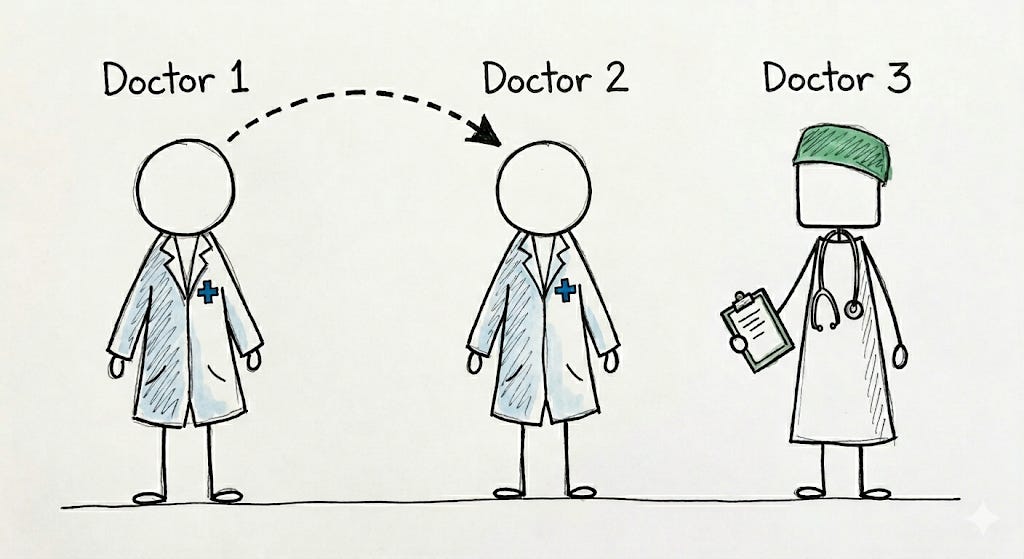
This is why I’m worried about a future where everybody trusts a homogenous pool of AIs. Even if the AIs make us all smarter, we’re going to all end up more epistemically dependent, which means potentially trapping ourselves inside a massive echo chamber. For example, suppose I come to think the stock market is going to go up because my AI and neighbor both tell me it will. I take myself to have two independent sources—but in fact my neighbor is basing her take on her own AI, which is just like mine. Here the AI is the guru, and my neighbor is the follower. By aggregating my two sources, I’m double-counting. This problem will only grow worse as more and more people share an AI, as their confidence builds and builds until it unleashes an “information cascade” in which everybody is so impressed by everybody else’s apparent confidence that nobody’s willing to speak against the consensus.
I hope I don’t have to explain how this could go wrong. Think of public opinions about wars, pandemics, genocides, radicalizing ideologies, emerging technologies, etc.

II. Alienation
There is also something pathetic and gross about being systematically alienated from one’s primary sources.
Imagine a student whose entire art education consists of talking with Claude about art history. This student can recite all kinds of facts, timelines, etc., but they have never actually experienced any art for themselves. (At most “absorbing” key facts that have been “extracted” for them.)
Imagine a student whose entire philosophy education consists of reading secondary sources on Kant, Plato, etc. without ever reading a single book by any major author. No allegory of the cave, no beating their head against the first Critique, no struggling to construct a coherent worldview out of disparate texts.
Imagine a student whose entire English education consists of vibe-reading great literature. This student can produce (or at least vibe-write) an essay on themes from Flannery O’Connor; they can tell you about the Catholic themes in her stories, about her troubles living with her mother—but they have never actually read a single story from start to finish.
I’ll let O’Connor explain why I find this all repugnant:
When you can state the theme of a story, when you can separate it from the story itself, then you can be sure the story is not a very good one. The meaning of a story has to be embodied in it, has to be made concrete in it. A story is a way to say something that can’t be said any other way, and it takes every word in the story to say what the meaning is. You tell a story because a statement would be inadequate. When anybody asks what a story is about, the only proper thing is to tell him to read the story. The meaning of fiction is not abstract meaning but experienced meaning, and the purpose of making statements about the meaning of a story is only to help you experience that meaning more fully.
A successful work of fiction is one that has to be the way it is—its ideas can’t just be “extracted.”
Something similar holds for great works of philosophy. Jonathan Dancy once told me “Nobody can teach you Anscombe.” His point was that Anscombe’s Intention is the sort of book I had to read for myself. (I’m also reminded of Frank Jackson’s case of Mary, the color scientist who’s only ever seen in grayscale. Sometimes there’s no substitute for seeing things with one’s own eyes.)
Conclusion
A major caveat is that arguably none of this holds if AI becomes so good that it blows human philosophy, art, and literature out of the water—in which case, even vibe-reading won’t be vibey enough. Just chat with the AI and let the river of gold flow forth.3
Still, however good the AIs get, I have doubts about the virtues of vibing. Won’t we still want to do some things for ourselves? Isn’t there intrinsic value in knowing stuff, developing one’s abilities, etc. over and above the contributions one can make to human society by doing so? Think of the joy people get from being good at sports—whose difficulty is entirely contrived—or from competitions like speedrunning.
My sense is that there is real value in being in contact with reality—and in contact with reality’s value itself, not just someone else’s evaluation. I’m reminded of something Thi Nguyen says in “What’s Missing from Cookbook Reviews”:
for so many of the recipes I’d come to love and make part of my life, my affection wasn’t only based on how the dish turned out in the end. It also came from what the cooking process felt like: how it felt to cut that kind of vegetable, the pleasures of the smells and sounds of garlic and green beans browning together. It’s about how my favorite pork and butternut squash stew makes the entire house drip with the most beautiful humid savory sweetness. It’s about, for my favorite Chinese steamed dish, how fun it is to layer the taro slices and the pork slices and the Chinese sausage bits, and the joys of peeking in under the steamer lid and watching that beautiful clear dipping liquid form around the edges. It’s about the joys of mixing and inspecting and poking and prodding.
In my view, college students are reading too few books in 2026 precisely because they aren’t in touch with the profound joys of reading book from cover to cover. They like “poking and prodding” a book, but only once you prod them into trying.
I can’t tell you how many students thanked me when I first assigned Frederick Douglass’s My Bondage and My Freedom. (Even though several considered dropping the class when they heard the page count.) I’ve had similar reactions to plenty of other books—particularly ones with historical influence, literary value, or O’Connor-style unity. If students had vibe-read Douglass, they probably would not have felt the same connection to him. I doubt they would have remembered much, either.
So while vibing has its place, I fear that the next generation will take it too far. Compared to the real thing, vibe-reading is quick, safe, and easy—an alluring combination, reminiscent of junk food (and innumerable other indulgences).
We would be fools to underrate AI—whose abilities are becoming ever more awesome—but the point of life isn’t to find the most intelligent being around and pledge yourself as a spineless, mindless follower. You should try to develop your own mind, which means striking a balance between leaning on others and, where possible, becoming independent from the herd.
How to make yourself read more books

When I was a kid, I loved reading books. I read in the morning, before bed, during math class. I would even skip classes to go to the library; one teacher used to call me the Hall Wanderer.
My argument isn’t meant to apply to manuals, dictionaries, almanacs, atlases, or other books that serve as mere vehicles of detachable facts. Vibe-reading those is a great idea.
I’ll add one more qualification at the end. (“Say it, then qualify it,” as David Lewis says.)
More generally, we don’t check all things that stand in the transitive closure of the source relation to us.
The transitive closure of a relation R is the smallest transitive relation that contains R. For example, the transitive closure of the “parent of ___” relation is the “ancestor of ___” relation: every parent is an ancestor, but ancestry (unlike parenthood) is transitive, i.e. your ancestors’ ancestors are also your ancestors.
(A definition like this is exactly the kind of “detachable fact” suitable for vibe-reading.)
“River of gold” is how Cicero referred to the works of Aristotle. Cicero is so respected—and Aristotle’s surviving works so unstylish—that scholars take this line to be significant evidence that Aristotle’s published writings no longer survive.
I love that O’Connor quote. It’s also useful for distinguishing between things you really need to read (like her short stories) and the huge number of books (not just user manuals and the like) where you really can just extract some information without any loss.
Kling's argument is a nonstarter: the opportunity cost of reading a book for 20 minutes and reading an online essay (or Claude) for 20 minutes is identical, regardless of how much the pool of information is increasing.
But how are you increasing epistemic dependence by replacing the original with a copy? That seems like a 1:1 trade. More broadly, how does relying on AI place you in an echo chamber if it has wide coverage? Of course you should read creative work directly, but in philosophy what matters is the ideas not the guru's words.
I don't vibe-read, but if it means actively engaging with the ideas in a text, asking questions, dialogue, etc., instead of just passively reading, maybe I should.