

Grieving for Tom Hill, a philosopher we need now more than ever
We've lost one of the greats: a deep thinker who wanted you to know why humans matter, what makes us equal, and why we shouldn't fear "a storm in the wilds."

As human beings we are part of nature, living, growing, declining, and dying by natural laws similar to those governing other living beings; despite our awesomely distinctive human powers, we share many of the needs, limits, and liabilities of animals and plants. These facts are neither good nor bad in themselves, aside from personal preference and varying conventional values. To say this is to utter a truism which few will deny, but to accept these facts, as facts about oneself, is not so easy — or so common. Much of what naturalists deplore about our increasingly artificial world reflects, and encourages, a denial of these facts, an unwillingness to avow them with equanimity.
—Thomas E. Hill, Jr., “Ideals of Human Excellence and Preserving Natural Environments”
I woke up to some painful news today: the death of Thomas Hill, Jr.—one of the most admired moral philosophers of his time, and the author of one of the great papers of the 20th century, “Servility and Self-Respect.”
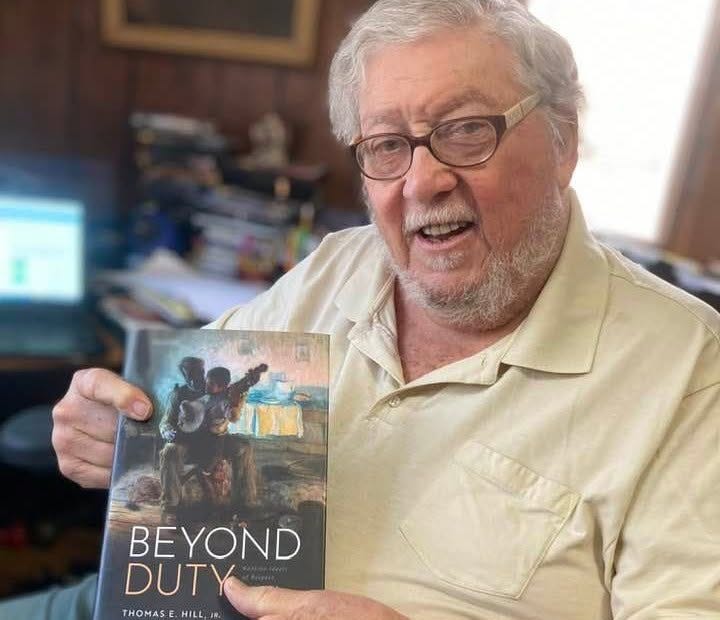
This is a huge loss for Tom’s family and loved ones, as well as for his many students (to whom he was devoted). It was also the loss of an important thinker, who had some quietly inspiring ideas about what made human life important—and, as a result, how we should feel about others and ourselves.
I take that back: “quietly inspiring” is too understated. No, Tom didn’t write in a grandiose style. He wasn’t polemical; he was anything but sensationalistic. But his moral philosophy was a profound challenge to our culture in 2020s—an era of looks-maxxing, vice-maxxing, people-shopping, defiantly unrestrained warfare, and fantasies of immortality.
Tom thought that ethics was in large part about our attitudes. Racist hatred, for example, is objectionable for the (obvious) reason that its target doesn’t deserve it. A human’s worth isn’t grounded in something as superficial as skin color; so, if you denigrate someone or their achievements purely on the basis of race, your attitudes involve a kind of moral distortion. But what made Tom’s work special is that he didn’t stop there. What, he asked, must the racists think of themselves? That they’re only worthy of love and respect because they happen to be of the right race? That is a kind of distortion, too—this time at the racist’s own expense. The racist who denigrates others also thereby denigrates the humanity in themselves.
In “Servility and Self-Respect,” Tom makes the same point in the opposite direction. The person who disrespects themselves is, in a way, disrespecting others, by virtue of missing what makes everybody matter. This paper features Tom’s best-known thought experiment, for which he will be remembered for many years: The Deferential Wife, who displays the vice of servility.
This is a woman who is utterly devoted to serving her husband. She buys the clothes he prefers, invites the guests he wants to entertain, and makes love whenever he is in the mood. She willingly moves to a new city in order for him to have a more attractive job, counting her own friendships and geographical preferences insignificant by comparison. She loves her husband, but her conduct is not simply an expression of love. She is happy, but she does not subordinate herself as a means to happiness. She does not simply defer to her husband in certain spheres as a trade-off for his deference in other spheres. On the contrary, she tends not to form her own interests, values, and ideals; and, when she does, she counts them as less important than her husband’s. She readily responds to appeals from Women’s Liberation that she agrees that women are mentally and physically equal, if not superior, to men. She just believes that the proper role for a woman is to serve her family. As a matter of fact, much of her happiness derives from her belief that she fulfills this role very well. No one is trampling on her rights, she says; for she is quite glad, and proud, to serve her husband as she does. (89)
Hill is careful here. The Deferential Wife might not be servile at all, depending on how we fill in the details. Maybe she was brainwashed and never had a way of knowing better? Maybe she can’t leave her husband and is making the best of a bad situation?1 Very possible. But it’s also possible that she simply doesn’t value herself enough—she may be serving her husband “just from laziness, timidity, or a desire for some minor advantage.” That, says Hill, is a moral defect. We shouldn’t let others walk all over us, even if standing up for ourselves requires a bit of effort and courage.
Nor does Hill stop there. Again, he asks, what kind of attitudes must this person have? In particular, think about how they must feel about others. The Deferential Wife is not some kind of subhuman species: she is a human being, with broadly the same cognitive, perceptual, and affective capacities as anybody else.2 If she isn’t worthy of basic respect, then nobody is.
Hill illustrates with another unforgettable example—the German dueling fraternity—though in my view, this example is massively underrated, because almost no philosophers have heard of it. In full:
Imagine a club, say, an old German dueling fraternity. By the rules of the club, each member has certain rights and responsibilties. These are the same for each member regardless of what titles he may hold outside the club. Each has, for example, a right to be heard at meetings, a right not to be shouted down by the others. Some rights cannot be forfeited: for example, each may vote regardless of whether he has paid his dues and satisfied other rules. Some rights cannot be waived: for example, the right to be defended when attacked by several members of the rival fraternity. The members show respect for each other by respecting the status which the rules confer on each member. Now one new member is careful always to allow the others to speak at meetings; but when they shout him down, he does nothing. He just shrugs as if to say, ‘Who am I to complain?’ When he fails to stand up in defense of a fellow member, he feels ashamed and refuses to vote. He does not deserve to vote, he says. As the only commoner among illustrious barons, he feels that it is his place to serve them and defer to their decisions. When attackers from the rival fraternity come at him with swords drawn, he tells his companions to run and save themselves. When they defend him, he expresses immense gratitude—as if they had done him a gratuitous favor. Now one might argue that our new member fails to show respect for the fraternity and its rules. He does not actually violate any of the rules by refusing to vote, asking others not to defend him, and deferring to the barons, but he symbolically disavows the equal status which the rules confer on him. If he ought to have respect for the fraternity, he ought to change his attitude. Our servile person, then, is like the new member of the dueling fraternity in having insufficient respect for a system of rules and ideals. The difference is that everyone ought to respect morality whereas there is no comparable moral requirement to respect the fraternity. (100)
In “Social Snobbery and Human Dignity,” Tom makes a similar point about people who respect only elites and high-achievers. After a winsome disclosure of the author’s own “strong personal aversion to snobbery, extreme enough to raise worries about ‘reverse snobbery’,” he goes on to argue that the snob’s attitudes betray a similar moral error as can be found in the servile person and the racist:
the main fault in snobbery is not error in judging the merits of individuals but rather failure to acknowledge the basic worth of human beings as persons. (156)
by measuring the worth of persons entirely by the variables of social class and/or individual merit, snobs fail to appreciate their own unconditional worth as persons. (157)
The essential error of the chauvinist of any stripe is to place the value of a human life in trifling and superficial things—refined taste, gender or race, etc.—rather than the deep fact that unites us: our shared humanity, the ability we each have to set our own goals and shape our own values, rather than responding heteronomously to our environments like mindless robots or natural slaves.
As I read Tom, he was in awe of the value of humanity—its value as an end in itself, he would surely add—and his touchstone for this was the work of Immanuel Kant. But I think it would be a grave mistake to pigeonhole Tom Hill as a “Kantian,” as if he were a disciple, less original than his contemporaries. To see Hill’s work—on humanity, duties to self, supererogation—as a mere footnote to one of the greats would be an injustice.
Hill was a great ethicist, which means that he has something important to tell us about coping with life and death. I began with a passage from his paper about humanity and nature, where Hill talks about the importance for humans of self-acceptance—not just of particular foibles, but of our most basic condition as parts of the natural world: our mortality, our particularity. Let me conclude with the rest of that passage.
Like the Victorian lady who refuses to look at her own nude body, some would like to create a world of less transitory stuff, reminding us only of our intellectual and social nature, never calling to mind our affinities with “lower” living creatures. The “denial of death,” to which psychiatrists call attention, reveals an attitude incompatible with the sort of self-acceptance which philosophers, from the ancients to Spinoza and on, have admired as a human excellence. My suggestion is not merely that experiencing nature causally promotes such self-acceptance, but also that those who fully accept themselves as part of the natural world lack the common drive to disassociate themselves from nature by replacing natural environments with artificial ones. A storm in the wilds helps us to appreciate our animal vulnerability, but, equally important, the reluctance to experience it may reflect an unwillingness to accept this aspect of ourselves. The person who is too ready to destroy the ancient redwoods may lack humility, not so much in the sense that he exaggerates his importance relative to others, but rather in the sense that he tries to avoid seeing himself as one among many natural creatures. (115)
Tom Hill thought that he was “one among many”—and thought that this was something anyone should be proud of. Rest in Peace, Tom. I’m grateful to have known you; I’m heartbroken by your death; and I wish you were still here for us to learn from.

…the Deferential Wife is not servile if she tolerates an abusive husband because he is so ill that further strain would kill him, because protesting would deprive her of her only means of survival, or because she is collecting atrocity stories for her book against marriage. If there is fault in these situations, it seems inappropriate to call it servility. (96)
Here we arrive at one of the most important Kantian premises of Hill’s moral philosophy: that the ways in which humans are alike matter more than the ways in which we differ. You can see this especially clearly in Hill’s “Ideals of Human Excellence”:
Kant once wrote that he had been inclined to think that dignity and respect should vary with intellectual achievement and that therefore professors should be accorded the highest dignity, presumably vastly superior to that of common laborers. But, he says, Rousseau saved him from this error and taught him that the important ground of dignity is in every human being. Thus Kant seems to admit a temptation to what I call talent and/or achievement snobbery, but he found this to be incompatible with his idea of human dignity. (168)
Note that page numbers are all for Tom's essay collection Autonomy and Self-Respect, which I strongly recommend. It's clearly written, meticulously argued, readable, and profound.
This is really sad. If there were something like a list of 'modern ethicists that non-philosophers should know about,' he'd be pretty high up on that list for me.
(Which reminds me: there's a lot of Tom Hill I haven't read, like "Ideals of Human Excellence and Preserving Natural Environments". I guess I know what I'll be doing on my weekends now!)