

Operation Rolling Blunder
Pete Hegseth promises a quick and easy victory in Iran. Don't count on it. His "Department of War" is making strategic mistakes based on an obsolete philosophy.

…“victory” inadequately expresses what a nation wants from its military forces. Mostly it wants, in these times, the influence that resides in latent force.
—Thomas Schelling, Arms and Influence (p. 31)
I’ll be blunt. The United States is waging war against Iran at enormous cost—both in taxpayer dollars and human life—and I don’t see any light at the end of this tunnel, partly because our leaders don’t appear to know, except on the most superficial level, what modern war even is.
I don’t just mean that our politicians are misusing the word “war”—though they’re certainly doing that. Five days after the spectacle of Operation Epic Fury, Speaker Mike Johnson told reporters, “We are not at war. We have no intention of being at war.” Two days later, President Trump boasted, “We’re winning the war, by a lot.” Sen. Tommy Tuberville called it “President Trump’s war” on March 3rd, and then on March 4th, said “I wouldn’t call this a war.” (Are you sure about that?)
No: I’m not worried about rhetoric. I’m worried that some officials in the Trump Administration have the wrong philosophy of war, which has led them to overrate war’s usefulness and underrate its difficulties.
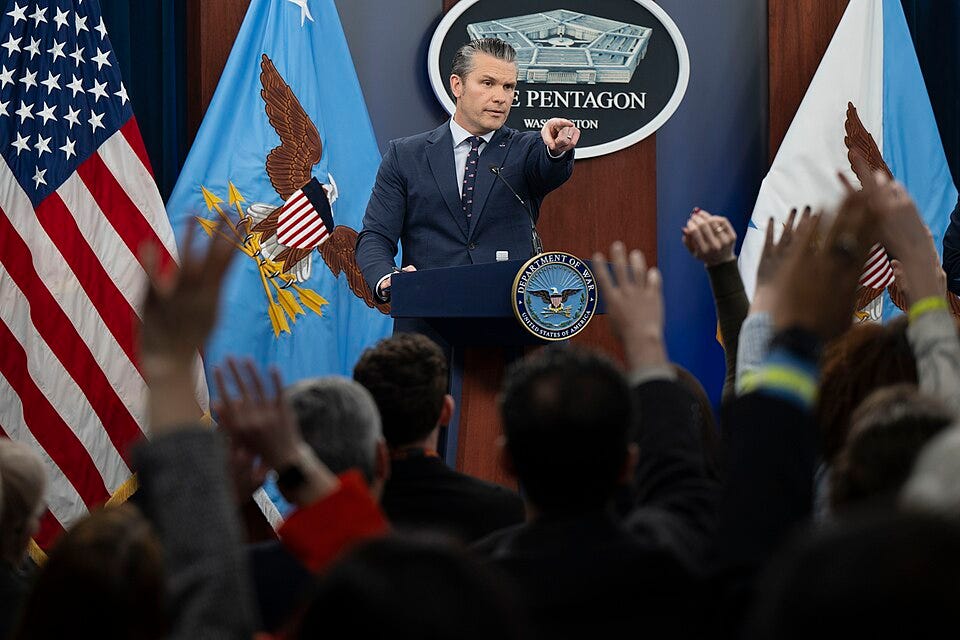
For Trump’s “Secretary of War” Pete Hegseth, the point of war is to achieve military superiority and use it to destroy your enemies. Destruction and domination are ends in themselves. Last year, Hegseth crystallized this philosophy into a slogan (effectively designed to needle liberals): “Maximum lethality, not tepid legality; violent effect, not politically correct.” Four days into the war, that same defiant machismo was on display in his remarks to reporters:
We’ve only just begun to hunt, dismantle, demoralize, destroy, and defeat their capabilities.
Hegseth then laid out his unsentimental vision for the next stages:
Death and destruction from the sky—all day long.
We are punching them while they are down.
This is a war without annoying bureaucratic restrictions—“no stupid rules of engagement,” as Secretary Hegseth put it. The day prior, the White House had described the Iran War in an article dripping with that same adolescent joie de guerre.
As America’s warriors deliver crushing, devastating hits to eliminate the threat of the Iranian regime once and for all, this is victory in action — decisive, relentless, and unstoppable.
When Hegseth talks of war, he is almost always talking about brute force, by which one country imposes its will on a weaker adversary. The opposite of force is diplomacy, by which two or more countries come to a mutually advantageous agreement. The Hegsethian philosophy of war, put simply, is that diplomacy is the refuge of wimps, and America (given its overwhelming strength) should be more willing to use brute force to get its way.
There are, of course, moral and practical objections to the selfish use of brute force. What of the rights of foreign noncombatants? What if start a war we can’t finish? How will any country be able to trust us in the future? What of the economic costs? The political aftermath? Human dignity? Etc.
But beyond these obvious ethical problems, Hegseth’s approach strikes me as strategically confused—collosally so. It is simply not the case that the primary business of modern war consists in the exercise of brute force. Far more often, what we call “war” is an attempt at coercion, in which outbreaks of violence are symbols not of present strength but of past failure.
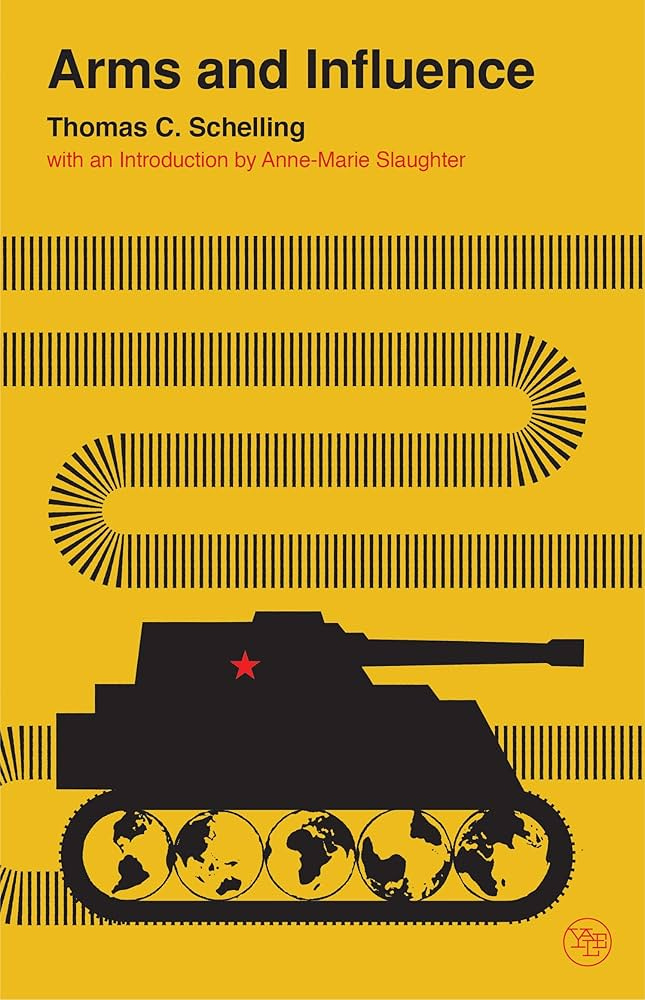
The distinction between brute force and coercion comes to us from Thomas Schelling’s 1966 masterpiece Arms and Influence. Here’s how Schelling introduces the idea:

There is a difference between taking what you want and making someone give it to you, between fending off assault and making someone afraid to assault you, between holding what people are trying to take and making them afraid to take it, between losing what someone can forcibly take and giving it up to avoid risk or damage. (p. 2)
Let me spell this out:
When I slash your tires because I don’t want you to be able to drive to work, that’s brute force. When I threaten to slash your tires unless you give me $100, that’s coercion.
When Genghis Khan kills every soldier in a village, that’s brute force. When Genghis Khan forces his captives to march in front of his army as shields, that’s coercion. (p. 6)
The crucial difference lies in the intention. Brute force is intended to achieve some goal directly, like destruction of military forces or the degradation of capabilities. Coercion is intended to achieve some further goal indirectly, through the action’s influence on enemy behavior—as in “give me the money, or else.” Brute force always involves violence, and this violence always has some concrete aim. Coercion only sometimes results in violence, and this violence may be pointless and ineffectual. Suppose you refuse to hand over the money, and I proceed to slash your tires. There is a kind of futility in what I’ve done. I didn’t want the destruction: I wanted the cash. That’s why Schelling says “brute force succeeds when it is used, whereas the power to hurt is most successful when held in reserve” (p. 3). Later, he puts it even better:
Violence is most purposive and most successful when it is threatened and not used. Successful threats are those that do not have to be carried out. (p. 10)1
The main insight of Arms and Influence is that, as warfare has modernized (due to the emergence of nuclear weapons, cheap means of mass terrorism, etc.), coercion has taken priority over brute force. Now, the best weapons are the ones that never fire.
Simplifying: In the old days, a country had to vanquish its rival’s military in order to get within reach of the rival’s civilian population. Now, with modern technology, a country can credibly threaten to inflict pain on the population from the start, or even after the end (when insurgents might also inflict pain back). Destroying the other military, as an objective, has become somewhat outdated.
To be sure, there are certainly many targets that the Trump Administration would like to destroy via brute force: nuclear facilities, missile launchers, planes, ships, soldiers, officers—even Supreme Leaders.2
But look at what’s actually happening right now in the Strait of Hormuz. Iran has mined and choked one of the most important shipping lanes in the world, disrupting international commerce and driving up the price of oil from $60 a barrel to over $100. This is acutely painful for the US, and Iran can keep the pain coming despite being utterly incapable of defeating our military. Why? Because the choking of the Strait is coercion, not brute force, so it doesn’t require military dominance. Iran just needs to be able to inflict pain. (President Trump, famously wary of rattling the markets, has already been assuring reporters that hostilities will end “soon.”)
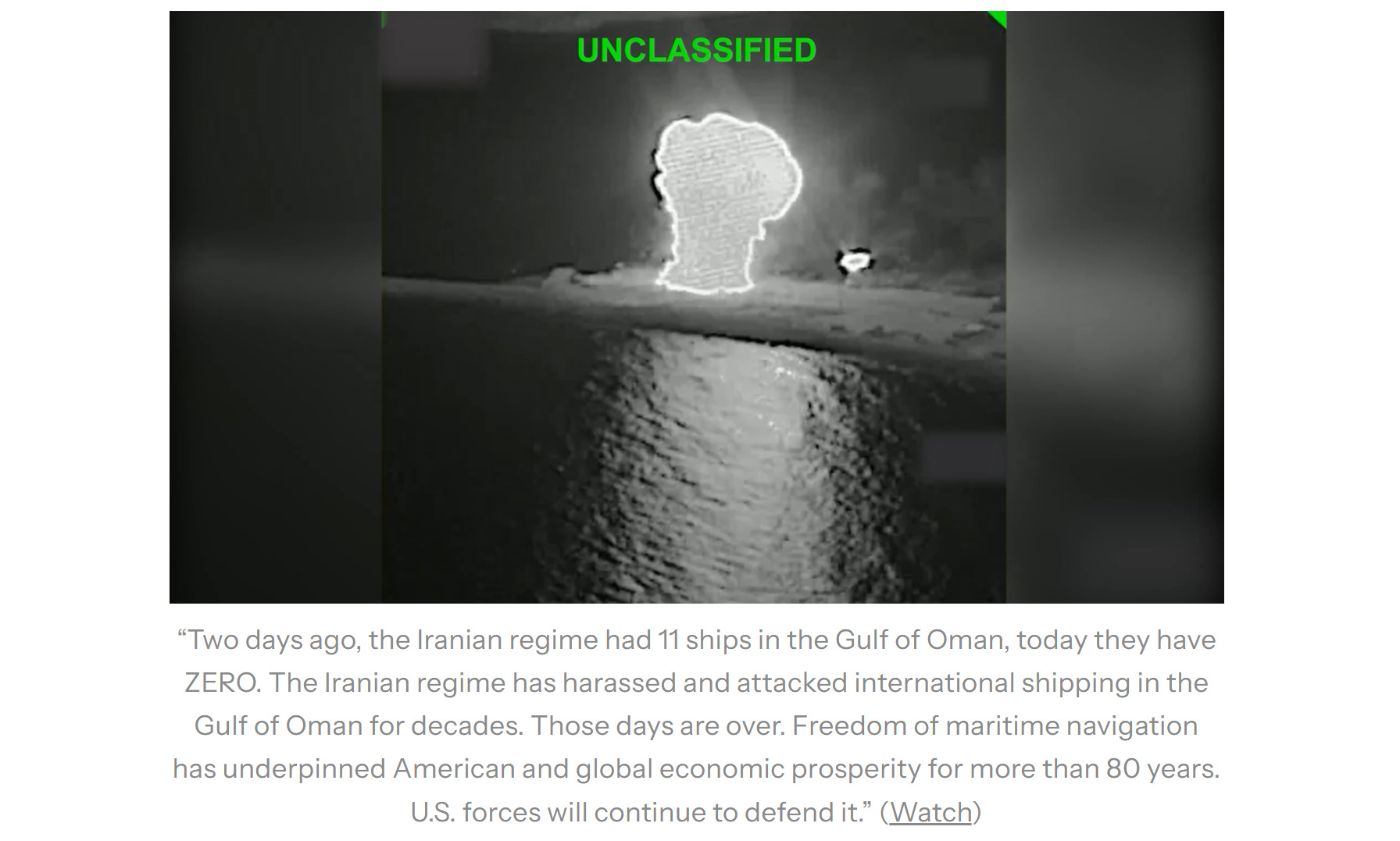
Contrast that with the abysmal failures so far of American coercion. Trump, perhaps under the influence of Senator Lindsey Graham, began the war promising regime change in Iran. “All I want is freedom for the people,” he told the Washington Post at 4am on February 28th, not even three hours after the first cruise missiles struck. Even though the US and Israel were able to kill Supreme Leader Khamenei (a fearsome display of brute force), they were not able to spur on a popular revolution, nor even the selection of a moderate successor. Iran’s defiant choice, instead, was of Khamenei’s son. Trump has given up for now on calls for revolution.
America has the arms, but where’s the influence?

.jpg)
Let me reiterate: even though the Iranian regime is profoundly unjust—repressing speech, extracting wealth, massacring its own citizens—there are also grave moral and prudential risks entailed by any American war in Iran.
But even if we grant for the sake of argument that some kind of military intervention could have been justified, was this justified?
I hope, of course, that everything will turn out well. Like any decent person, I want the Iranian people to be free and prosperous. But as I look at the first weeks of the war, I see few reasons to be optimistic. Part of the problem may simply be that the administration has little patience for strategic thinking. John Bolton, former National Security Advisor to President Trump, said last weekend that his former boss “doesn’t think ahead. He doesn’t have a strategic plan. He just makes decisions by the seat of his pants.”
My point, however, is that this administration is losing sight of the strategic value of diplomacy—not only as an alternative to war, but as an integral part of it. If the goal is to get the Iranian people to start a revolution, you have to be a credible protector: you can’t just promise “Help is on the way” one moment, and then the next (as oil prices tick up), turn around and say “We’re out of here.” If you want to empower Iranians who are sympathetic to America, you shouldn’t let your missiles land anywhere near a girls’ school. If you want moderate leaders to take over, you shouldn’t let them end up as collateral damage on day one of the conflict. It’s not enough to show that you’re willing to use your big stick in wartime: you also have to show that you can be trusted not to abuse it in peacetime. (How are you supposed to pull that off? One way is to subject yourself, as a costly signal, to strict rules of engagement. Of course, such rules will seem “stupid” to a leader who thinks of war as a contest of brute military force—i.e. as pure, essentially undiplomatic violence. Here a bad philosophy leads to bad strategy.)
The essence of diplomacy is that it’s nonzero-sum. You have to cooperate, in some sense, even with your adversaries: they need to trust that you’ll follow through on an eventual agreement—and, prior to that, they at least need to be able to understand your proposals. Deterrent violence won’t work if the other party expects you’ll keep going even after they back off. “Compellent” violence—another concept from Schelling—won’t work if the other party can’t tell what you’re trying to compel them to do. (“Give me what I want, or I shoot” is a bad threat if your target doesn’t know what you want. It’s even worse if they think you’ll shoot regardless.)
Hegseth’s worldview, alas, has no room for even these elementary thoughts about trust, clarity, and coordination; his philosophy of war is as zero-sum as it gets. The “Department of War” might as well be called the “Department of Brute Force.” Its leader, rather than returning us to peak performance, may well be sending us back to the Stone Age.
Schelling gets the last word:
Military strategy can no longer be thought of, as it could for some countries in some eras, as the science of military victory. It is now equally, if not more, the art of coercion, of intimidation and deterrence. The instruments of war are more punitive than acquisitive. Military strategy, whether we like it or not, has become the diplomacy of violence. (p. 35)
Withheld violence—successfully threatened violence—can look clean, even merciful. The fact that a kidnap victim is returned unharmed, against receipt of ample ransom, does not make kidnapping a nonviolent enterprise. (p. 10)
Later, Schelling quotes from a British Air Chief Marshal’s lecture:
It would be the greatest mistake to believe that a victory which spares the lives and feelings of the losers need be any less permanent or salutary than one which inflicts heavy losses on the fighting men and results in a “peace” dictated on a stricken field. (p. 14, fn. 5)
The insight remains relevant.
Some of these targets (e.g. missile launchers) are less important for American interests than for those of other parties to the conflict—notably, Israel, which is (obviously) much closer to Iran than we are. Unfortunately, it is not clear what role Israeli interests played in the decision to go to war with Iran, in part because American officials (like Marco Rubio) have given contradictory accounts of whether Israel would have attacked Iran even without us.
'Now, with modern technology, a country can credibly threaten to inflict pain on the population from the start, or even after the end (when insurgents might also inflict pain back). Destroying the other military, as an objective, has become somewhat outdated.'
I think this is what the European pacifist left does not (or, I suspect, refuses to) understand about the necessity to adopt a more coercive approach towards Russia. Nobody thinks that the Russian army is able to steamroll straight to Warsaw. But the war in Ukraine has shown that it remains a force capable of inflicting unspeakable damage and loss of life even while enduring tactical defeat and WW1-level combat casualities. It is against *that* that Europe must arm itself, not against imperialist annexations or what not.
> The Hegsethian philosophy of war
Must philosophy sit so close to Hegseth in a sentence.