

Why I got into this game
Upcoming interview with Ian Shapiro: June 2nd, 9AM Eastern

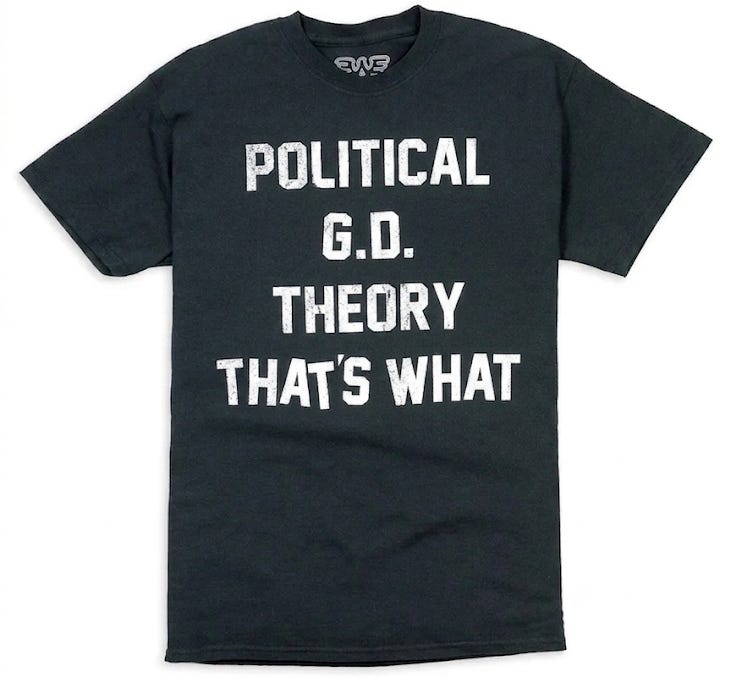
Once, at a dive bar in Dallas, I saw a guy who had on a shirt that said
WAYLON
G.D.
JENNINGS
THAT’S WHO
Well, that’s how I feel about my next interviewee.
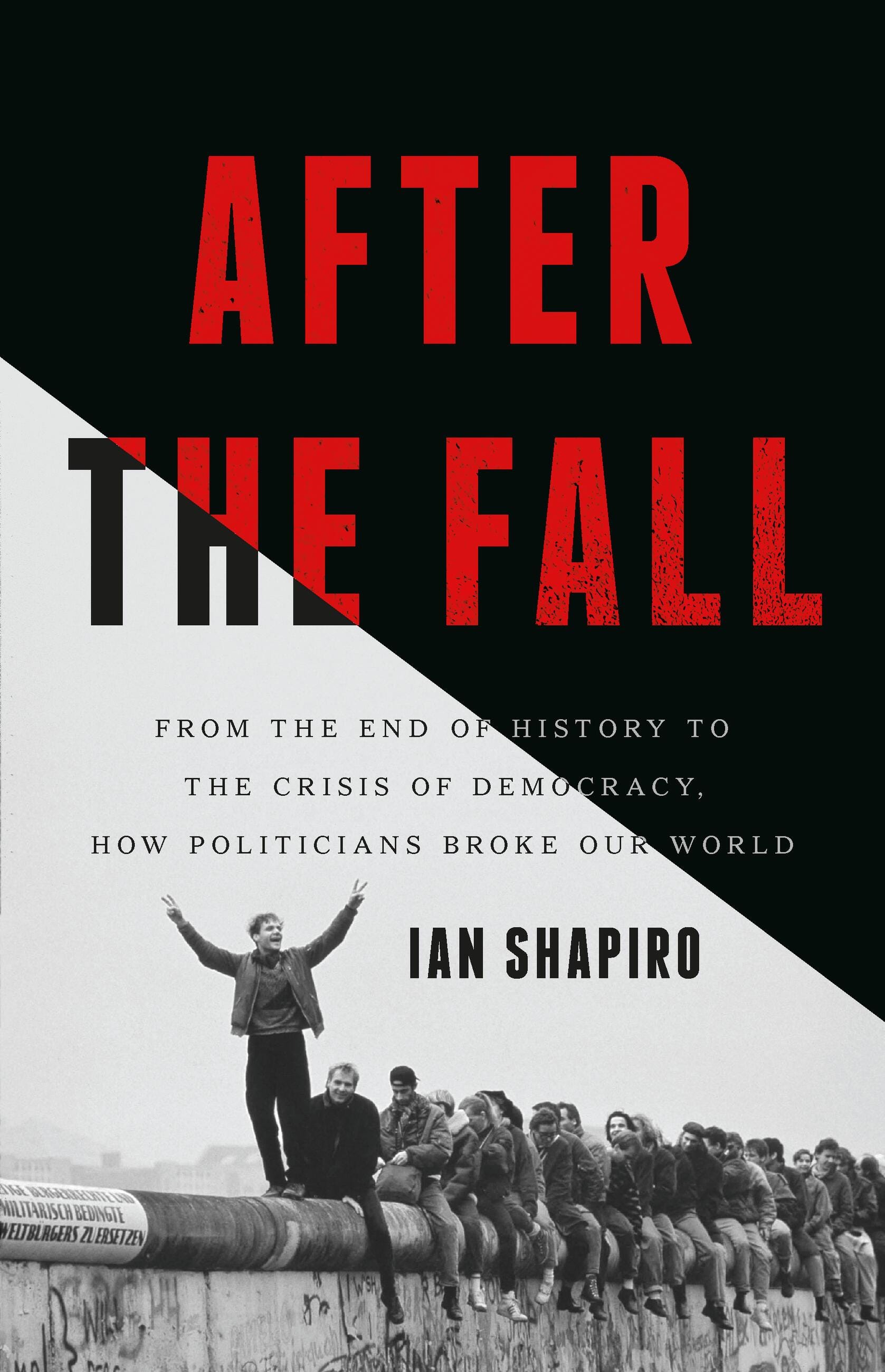
On June 2nd, I’ll be talking with Ian Shapiro, Sterling Professor of Political Science and Global Affairs at Yale University. We’ll be discussing his new book, After the Fall: From the End of History to the Crisis of Democracy, How Politicians Broke Our World, which is a bracing critique of neoliberal “triangulation,” the Global War on Terror, and other major trends in post-Cold War Western politics. The book expands on Ian’s brilliant DeVane Lectures, which you can (and indeed must) watch for free on YouTube.
I’m also hoping to ask Ian about his oeuvre more broadly, especially:
Moral Foundations of Politics
Death by 1000 Cuts (on the estate tax)
Containment (a critique of the Bush Doctrine)
Wolf at the Door (on insecurity & inequality)
Responsible Parties
And—of course—I’ll ask for his thoughts on events since he finished the book, such as the Iran War and Trump’s actions in Venezuela.
To give you a flavor of what to expect, let me share a few Shapiro passages I love. If there’s a theme here, it’s that politics is hard, and the human condition is one of precarity and ignorance. (Emphases added.)
On methodology
The specialization that has divided political philosophy from the rest of political science has been aided and abetted by the separation of normative from empirical political theory, with political philosophers declaring a monopoly over the former while abandoning the enterprise of “positive” political theory to other political scientists. This seems to me to have been bad for both ventures. It has produced normative theory that is no longer informed, in the ways that the great theorists of the tradition took it for granted that political theory should be informed, by the state of empirical knowledge of politics. A result is that normative theorists spend too much time commenting on one another, as if they were themselves the appropriate objects of study. This separation has also fed the tendency for empirical political theory to become banal and method driven—detached from the great questions of the day and focused instead on what seems methodologically most tractable. Both types of theory have evolved close to the point where they are of scant interest to anyone other than their practitioners. This might bump up citation indexes and bamboozle tenure committees in the desired ways, but it scarcely does much for the advancement of knowledge about what is or ought to be the case in politics.
On politics and the human condition
People often know more about what is inadequate than what would be adequate. During the 1980s, many who lived in Soviet bloc countries could detail the fine contours of their oppression, as could victims of apartheid in South Africa. Yet they could supply only haziest accounts of what their worlds would be like without communism or apartheid, and why they would be better. Comparable stories could be told about those who have opposed fascism and other forms of subjugation. The inability to depict the details of a viable alternative was not a failing on their part. It reflected the reactive character of the human condition. People reject what is painful and oppressive in the hope that something better can be created, even though the destination and path forward are often, perhaps congenitally, shrouded in fog.
—Politics Against Domination, Ch. 1
On domination and imagination
Modern democratic movements emerged to oppose domination, sometimes by centralizing monarchs, sometimes by imperial overseers, sometimes by exclusionary elites. This needs emphasis because too many theorists of democracy are ignorant of this rationale or lose sight of it. This leads them to focus on contrived problems and mount spurious attacks on democracy. Efforts to combat domination by democratic means always have mixed results and sometimes spawn new kinds of domination. Life has more imagination than us. But no political institutions yet devised have done better, so that fostering, defending, and improving democracy remain central to resisting domination.
—Uncommon Sense, p. 4
Do you have any questions for Ian? If so, leave a comment!
Thanks for reading, and I hope you’re having a good summer. (I’m in Berlin through mid-July, by the way. Don’t ask me how many Ian Shapiro books I had stuffed inside my suitcase.)
Questions:
(1) How effective is judicial review as a means of enforcing rights? The naive view would seem to be judicial review is an essential mechanism by which rights are recognized and protected in a liberal democracy. However, the idea that an unelected body of lawyers with no army at their disposal would be able to compel a government to respect rights or would be able to change attitudes within a citizenry seems pretty implausible to me. If I’m right and most of the work of rights protection is being done through democratic (majoritarian) mechanisms (a view consistent, as it so happens, with that of Robert Dahl iirc), what is the actual role and impact of judicial review in a democracy?
(2) There is a body of literature exemplified by Frances Lee that links dysfunction in American government with the increasing competitiveness of American elections. If I recall correctly, this literature takes increasing electoral competitiveness as a given but doesn’t explain why this has come about. Does Professor Shapiro have any insight?
(3) From a structural perspective, are term limits for presidents wise? On the one hand, term limits prevent entrenchment of power by forcing circulation of elites. However, limits also prevent widely popular leaders from continuing to hold office, thereby frustrating democratic choice (think about how different American politics would be if Obama could run again). Term limits also seem like they remove incentives for term-limited politicians to continue to work within the system, creating a greater chance that they will engage in illegal or unconstitutional conduct to remain in power. I’m quite confused by how to square these differing considerations; I also expect there are other considerations I haven’t identified.
(4) Somewhat relatedly: why has the US avoided military coups while significant portions of Central and South America periodically fall prey to coups?
(5) How large should Congress be? What are the relevant trade-offs?
(6) How predictive of actual behaviour is Niskanen’s budget-maximizing model?