

In November 2016, I gave my first ever lecture. Admittedly, this did not turn out to be the most memorable thing that happened in that particular month in world history. But I did learn something.
I was a guest in Caspar Hare’s “Problems of Philosophy” at MIT, presenting on Derek Parfit’s “Personal Identity.” Not a bad debut, in hindsight. But as Caspar gently explained afterwards, I’d made a rookie mistake. I didn’t ask good questions.

Nobody wants “lectures” to be pure lecturing: every once in a while, the speaker should take a strategic break from yakking and ask the audience what they think.1 This can function as a test, a way to check that the audience knows what they’re supposed to know. Or it can be a hook, piquing interest in a question whose answer has yet to be revealed.
My questions, alas, fell a bit flat. The problem was a very common one. Some of my questions were painfully obvious (“2+2=___?”), while the others were intimidatingly difficult (“What’s the weakest modal logic in which this argument is valid?”). Good questions are Goldilocks questions, right in the middle.
Patrick Winston puts it well in “How to Speak”:
The question has to be carefully chosen. It can’t be too obvious, because then people will be too embarrassed to say what the answer is. It can’t be too hard, because then nobody will have anything to say.
Of course, taken literally, that’s a tautology. Obviously your questions shouldn’t be too hard or too easy—they shouldn’t be too anything!
So what actually makes for a good question?
Hooks
My favorite hooky question of all time comes from the Stanford mathematician Tadashi Tokieda. Let me set the scene.
Standing on a chair in front of the classroom, Tokieda presents the audience with a looooong paper rectangle. He then glues the ends together to create “an ordinary strip”—a loop with no twists or turns. “If I cut this strip along the center line,” he asks, “what’s going to happen?”
Easy: you get two similar strips, each half the original width. He cuts the loop, and down the strips float.
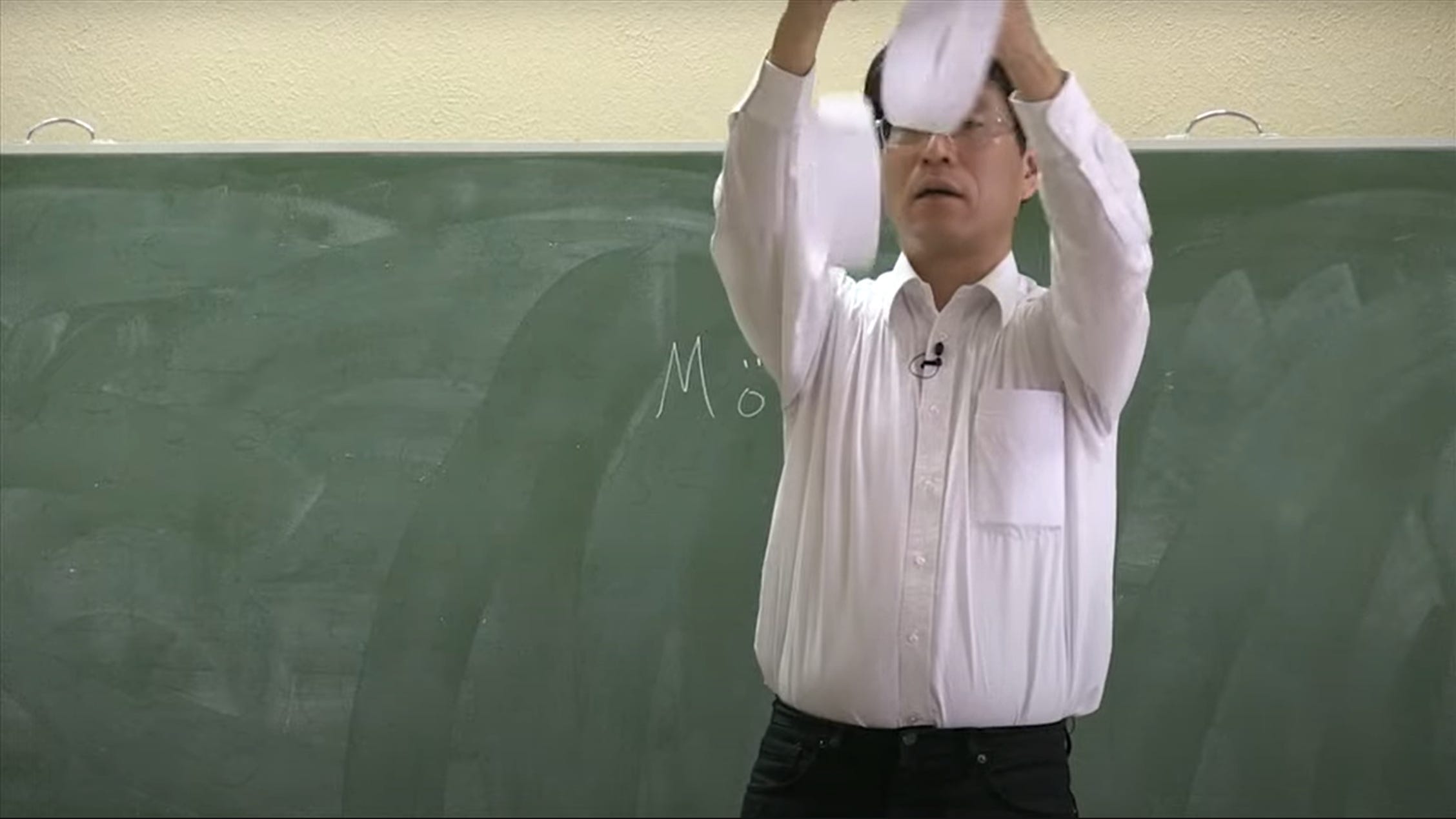
Next comes the twist. Tokieda takes a fresh piece of paper, glues it with a (“half”) twist, creating a Möbius strip. He then asks the killer question:
What happens if I cut it along the center line?
Tokieda asks for students’ names and more guesses. Justin guesses that it will form two entangled strips. Another student guesses the same. Tokieda prods his audience:
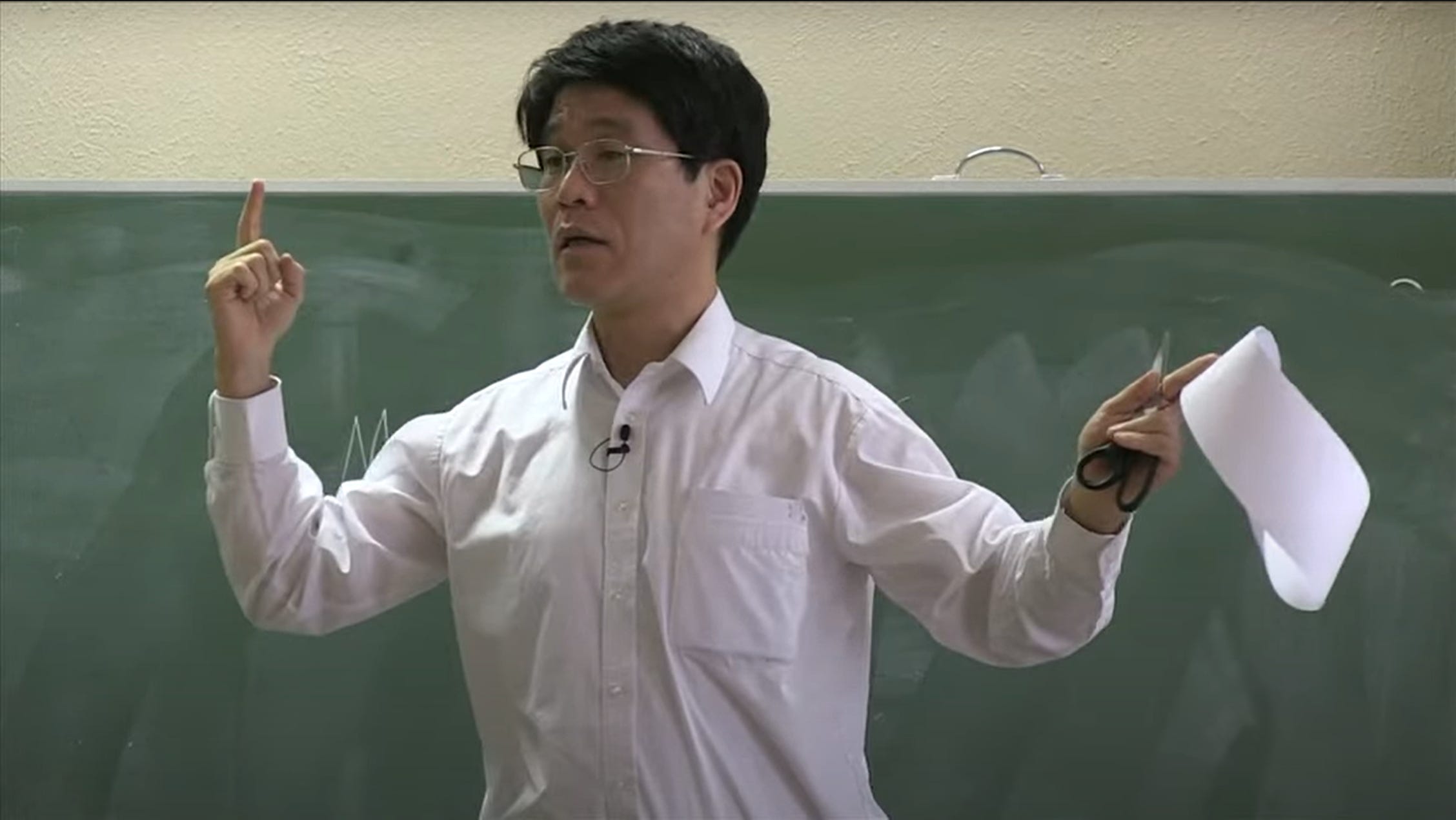
Any other guesses? You should guess. The first lesson (or the zeroth lesson) in mathematics is that you should always begin by guessing—if possible, in public—so that you are committed.
Now you are interested, your stakes are high, and you have to find out what’s going to happen. And you learn much better.
A third student guesses that there will be two strips that fall apart. A fourth concurs. Satisfied, Tokieda cuts along the center of the Möbius strip, pausing at the dramatic final moment.
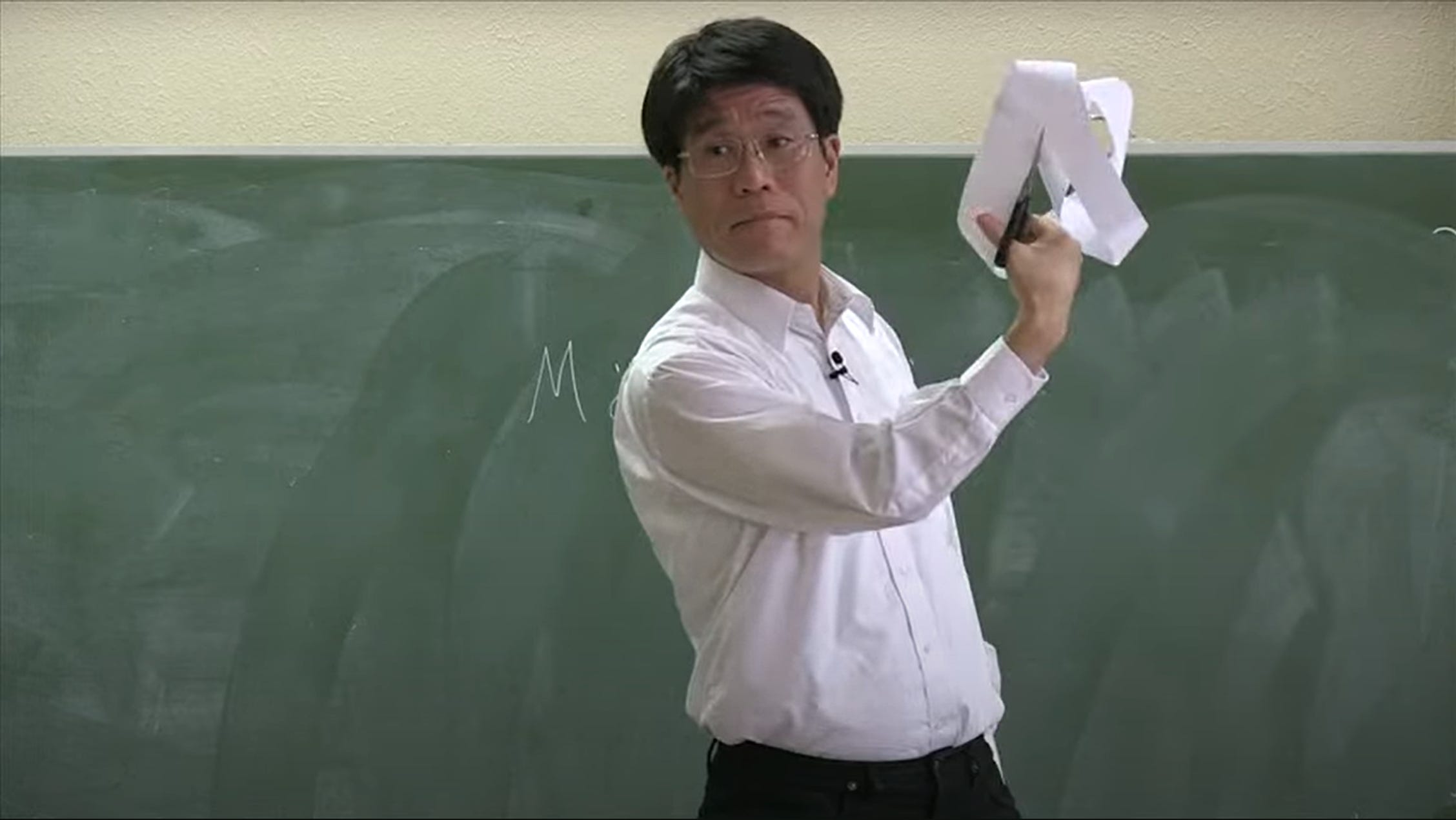
What happens next?
…
…
…
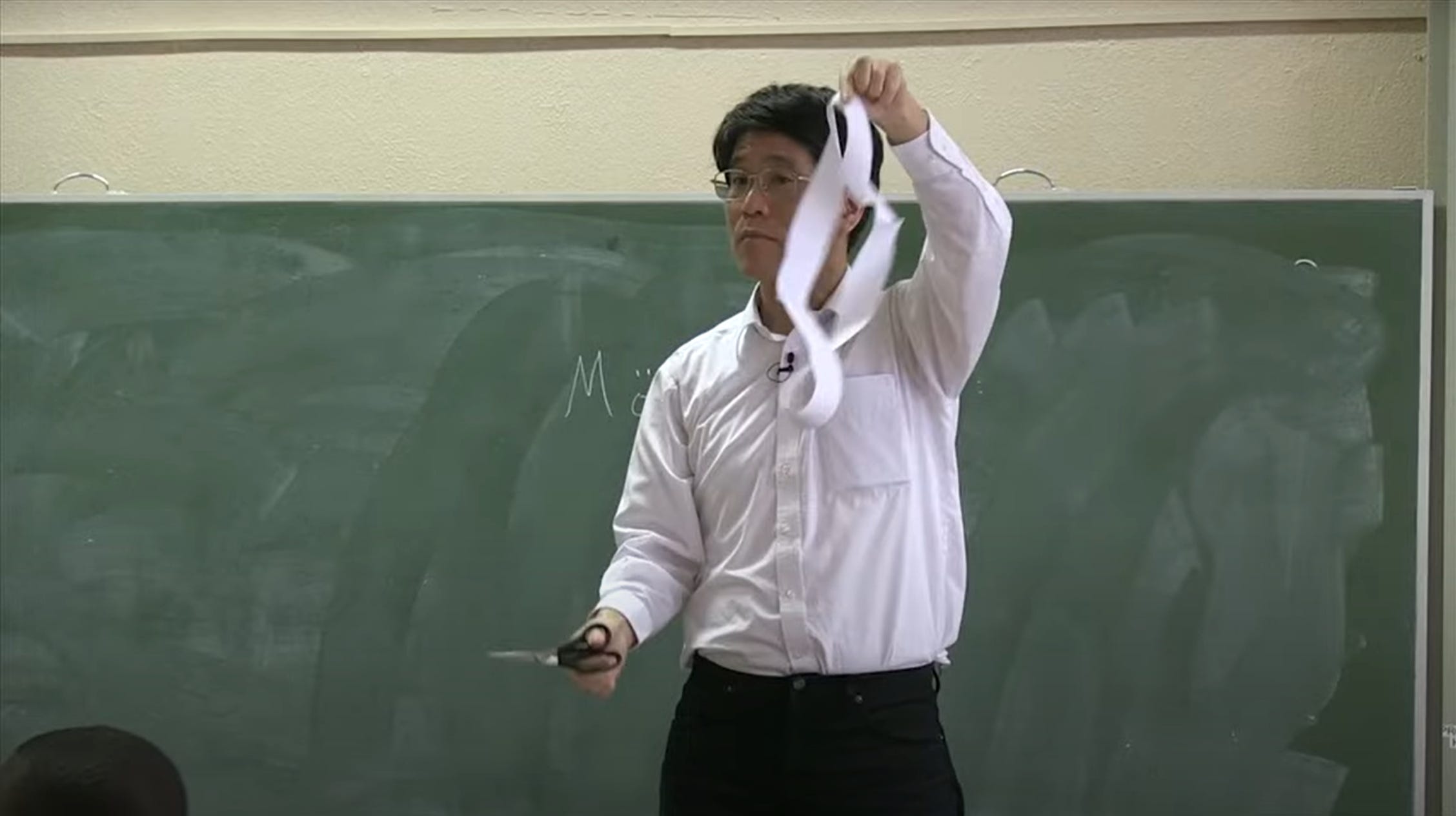
A single strip, twice the length—and with twice the twists!
I love this sequence so much. What makes it such an effective hook?
The question invites guesses — students aren’t dumbfounded or intimidated when they hear it: they can concoct and share hypotheses. (In this case, Tokieda has warmed them up with his easy question about the ordinary strip.)
There’s more than one plausible answer — instead of tricking students into giving a single intuitive-yet-wrong answer (as in the Wason Selection Task), Tokieda elicits multiple guesses, creating dramatic suspense.
The atmosphere is playful — from the very start, as Tokieda silently lifts, spins, and stands upon a backwards-facing chair, students are laughing, letting their guards down and their minds wander.
The next few minutes of Tokieda’s lecture are equally dazzling (“what if you cut along the 1/3 line?”), displaying all the same virtues and then some.
You can find similar virtues in Michael Sandel’s lectures.2 At the start of “Justice,” Sandel asks his students to imagine being the driver of a runaway trolley.3 Straight ahead are five workers, stuck on the track. On the side track is only one worker. What would you do? Drive ahead, or turn the trolley? Sandel’s students give conflicting answers. They even switch answers when presented with variations on the case. (Better that one should die than five, you say? So you’d push a guy in front of the trolley, if that stopped it from plowing into five others down the track?)4 The tension in the room is palpable, and it propels the lecture like a rocket. Just like Tokieda’s questions, Sandel’s are playful, inviting, and open to multiple plausible answers.

But not all good hooks have to be like Tokieda’s. Last term, the Stanford political theorist Emilee Chapman gave a talk on voting for UNC Chapel Hill’s PPE Program, at the heart of which was an irresistible question. Paraphrasing:
If an AI knows your preferences—and knows all about the candidates—why not let it vote for you?
Students were hooked. So was I!
Chapman’s question didn’t involve paper props or imaginary trolleys. Nor was there any geometric demonstration of a definitively true answer. (Hard to find, in my field.) But like Tokieda’s paper strip, Chapman’s AI got people wondering. We had to find out what would happen next.
Tests
As a teacher, I have a list of worst nightmares, and at the very top is the Ferris Bueller tariff scene:
Ben Stein is testing the students’ knowledge. But he’s doing it in the most boring way imaginable, droning on and on, asking students to fill in boring blanks with boring answers.
In 1930, the Republican-controlled House of Representatives, in an effort to alleviate the effects of the—anyone? anyone?—the Great Depression passed the—anyone? anyone? the tariff bill?—the Hawley-Smoot Tariff Act, which—anyone? raised or lowered?—raised tariffs in an effort to collect more revenue for the federal government.
Did it work? Anyone? Anyone know the effects? It did not work, and the United States sank deeper into the Great Depression.
What’s wrong here? Let me count the crimes.
The vibe is off.
The answers are obvious.
Nobody cares about the topic.
Peppering the audience with simple factual questions is a legitimate technique, but it’s no substitute for a hook.
So, supposing you’ve hooked your audience already, how should you be testing them?
First, make sure you get answers. Stein’s students are drooling in silence, not actively answering, and that’s partly his fault. Stein is only asking his questions half-heartedly (anyone? anyone?), preferring to answer his own questions instead of relying on the students. He’s not willing to wait, to suffer through the silence.
Silence can indeed be uncomfortable. But that’s precisely why it’s so effective for getting your audience to talk to you. Once it’s clear that the silence won’t clear up on its own, people will find the courage to say something. You have to trust the process.
Take it from Winston:
How much dead air can there be? How long can I pause? I counted seven seconds. It seemed like an eternity to me, to wait and not say anything for seven seconds, but that’s the standard amount of time you can wait for an answer.
Here’s a second tip. Even if you’re just quizzing people on facts, you still have to set up your questions. Think of Tokieda’s ordinary loop. He contructs it in front of the audience’s eyes from a humble piece of paper. He explains what it is, waves it around, stands up tall so that the audience can see what he’s holding. Only then does he pause and ask his question. That’s a lot of pomp for such an easy test. But it pays off.
Third, encourage bravery. Both Tokieda and Sandel praise students for being “brave” in their first lecture. Even if that’s a bit tongue-in-cheek, it sets the right tone. Now the audience knows they’re supposed to take swings, and it’s not the end of the world if they whiff. (This is another advantage of hard questions: there’s no shame in whiffing. It’s also a reason not to lay on the praise too thick when someone gets the right answer. Any subsequent absence of gushing praise will be acutely felt.)
Finally, mix up the difficulty. For example, you might build up confidence with an easy question or two, then use that as a foundation to ask harder and harder questions. Or try stumping them up front and then guiding your audience towards the answer with a breadcrumb trail of easier questions.
One of my favorite talks ever was Bob Pasnau’s “Who Killed Agent Causation?” Pasnau turned what could’ve been a bone-dry history of ideas into a thrilling whodunit—his handout maintained suspense by redacting the names of key figures. Near the end, when Pasnau asked for final guesses as to the killer, the second guess—due to my colleague John Roberts—got the true culprit. The audience immediately burst into applause. Who knew academic talks could be so entertaining?
Circling back
Asking what makes for a good question is a bit like asking what makes a joke funny. “The letter K is funny,” as Craig Ferguson once said. But as Jonathan Dancy replied, “That’s about all one can do.”
So please don’t take this as an attempt to pin down the Platonic form of interrogatives, or to lay out exceptionless principles for any conceivable context.
I just wanted to emphasize that there’s an art to asking questions, and that the best speakers spend as much time thinking about what to ask as they do thinking about what to say.
In the bad old days, neo-Thomists like Mortimer Adler would talk of students’ brains as if they were passive recepticles for the “cream of liberal education.”
Human differences in capacity for education can be thought of in terms of containers of different sizes. Obviously a half-pint jar cannot hold as much liquid as a quart or gallon jar. Now the poorly endowed child is like the half-pint jar, and the gifted child like the quart or gallon container.
See his Liberal Education in an Industrial Democracy, p. 35. Quoted and skewered in Sidney Hook, Education for Modern Man, p. 18.
In terms of sheer butts-in-seats objective metrics, Sandel is the undisputed champion of the mid-lecture question. Over 15,000 students have taken “Justice,” an all-time Harvard record. 39,000,000 have watched the first lecture on YouTube. He’s even a legend in China, where China Newsweek named him the “most influential” foreign figure of 2011. (Not “most influential academic”—most influential figure!) The hallmark of Sandel’s teaching is a Socratic dialogue at scale. He’ll elicit answers to tricky moral questions from a gargantuan audience, then use the tension between distinct answers to propel the lecture forward. This is difficult stuff, and it requires thoughtful planning. He can’t rely on his knowledge of individual students to know whom to call on. He has to pick questions so that he knows the answers in advance.
For more trolleys, check out Ethical Theory: 50 Puzzles, Paradoxes, and Thought Experiments, my intro book with Sarah Stroud, which features three entries just on the Trolley Problem. (Audiobook coming soon!)
Here, Sandel cheats a bit. His student didn’t actually say “better that one should die than five should live.” She said “it can’t be right to kill five people when you can only kill one person instead.” Killing isn’t the same as letting die! For that matter, “What would you do?” isn’t the same as “What’s the right thing to do?” This lack of analytical precision doesn’t seem to have detracted from Sandel’s popularity, but it drives me nuts.
But maybe you have pinned down the platonic form, which can be extrapolated from your examples: a good audience question is one that has more than one “obvious” answer. And the platonic form of a good audience question would be one that elicits an antinomy — a contradiction in which both sides can be rationally defended. Those are also the best jokes :).