

What was he thinking?
On April 2nd, “Liberation Day,” President Donald J. Trump stunned the world with a slew of historic tariffs, including 10% on the UK, 20% on the EU, and a whopping 46% on Vietnam. The reaction was swift and grim.
For a sense of the fallout, here are some right-of-center headlines:
Trump’s Tariffs Wipe Out Over $6 Trillion on Wall Street in Epic Two-Day Rout (WSJ, 4/4/2025)
President Trump’s Tariff Formula Makes No Economic Sense. It’s Also Based on an Error. (Kevin Corinth and Stan Veuger, AEIdeas, 4/4/2025)
Trump’s ‘Liberation Day Was Even Worse Than Expected: This is perhaps the worst economic own goal I have seen in my lifetime (Tyler Cowen, The Free Press, 4/2/2025).
Trump has defended the tariffs as a way to revive manufacturing, pay down the debt, get leverage on our neighbors, move away from the national income tax, and (I swear this is real) intentionally crash the stock market:
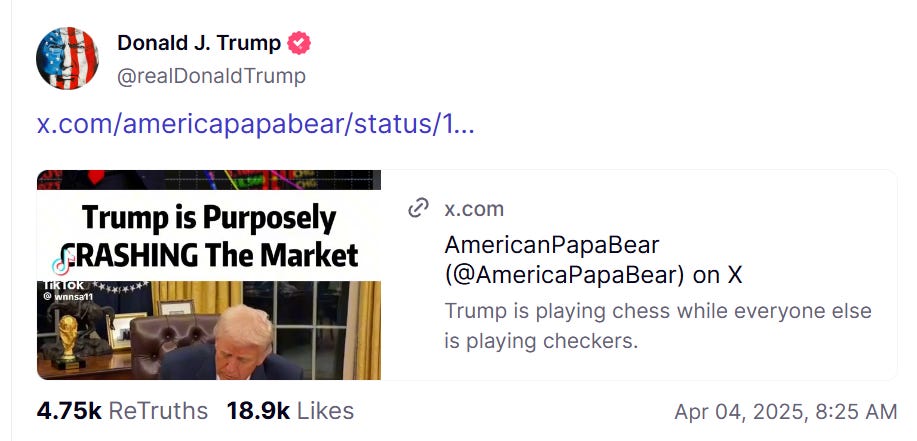
But Trump’s main argument—one he’s been giving since 1987 to anyone who will listen—is about exploitation. The US is being ripped off, says Trump, with other countries slapping us with higher tariffs than we slap on them. If we don’t retaliate, we’re suckers.
Now, if Trump’s point is just that it sucks to be a sucker—that it sucks so much that he’d rather permanently wreck the economy than let a single country rip us off—that’s one thing. But a lot of Trump’s supporters don’t want him to wreck the economy. They want us to be rich, and they are hoping that last week’s pain will be a brief prelude to a future where our economy’s booming and no one’s ripping us off.
If that’s the future you want, let me give you one reason to be very worried. It’s not just that Trump is wrong on the facts.1 He’s got entirely the wrong kind of strategy. He’s apparently fallen for the Sucker’s Fallacy, the idea that you need to come out ahead in particular transactions if you want to get ahead overall. The reality is the reverse. In life, those who are never ripped off are rarely best off.
You can get a feel for the fallacy just from working through a few examples. Think of The Sopranos. Though it’s common knowledge that some Soprano captains regularly turn in light envelopes, Tony keeps the peace by looking the other way, considering it “the price of doing business.”2 The show rightly presents this as a shrewd approach. If Tony tried to chase down every subordinate who withheld any money, he would soon find himself without any subordinates. Or for a real-life example, think of Robert Moses, who built his power in New York in part by routinely overpaying for contracts and offering banks extremely generous terms for loans. Because he was willing to be “ripped off” by so many powerful people, there were a lot of people fighting hard to keep Moses in power.3
But to more rigorously understand the Sucker’s Fallacy—and why we’re at risk of heading towards a poorer, nastier future—we need some game theory.
In the game theory trenches
Game theory is the study of strategic interactions. As it happens, on Liberation Day, I was teaching a seminar on one of the all-time classics of the subject: Robert Axelrod’s The Evolution of Cooperation.
Axelrod wanted to know how people manage to cooperate even though the logic of cooperation seems to make no sense.
The classic problem here is the Prisoner’s Dilemma. Suppose you and your opponent each face a choice between cooperating and defecting. No matter what the other does, you’d each prefer to defect; this makes defecting a “dominant strategy.” But the benefit you can get for yourself by defecting is less than the benefit you can get from your opponent if they cooperate with you. So, mutual defecting is worse for everyone than mutual cooperation. Assuming that rational agents always play their dominant strategies, that means you’re both destined for a lose-lose situation. You’re doomed by your own rationality.
It’s not just prisoners, of course. The same problem arises everywhere. Pirate a show or pay for a subscription? Drive a gas-guzzler or take the bus? Overfish or take your share? Etc.
So why isn’t everyone defecting all the time on everything?
Axelrod’s answer is that we’re often playing repeated games. Instead of just going home after the first round, we have to encounter each other again and again.
This fundamentally changes the nature of the interaction: players can now adjust their behavior in light of earlier rounds. As a result, assuming the game goes on long enough, defecting won’t be a dominant strategy anymore. In fact, there won’t be any dominant strategy. If your opponent is a saint who cooperates no matter what, then sure, you should defect every round. But if your opponent is obsessed with revenge, you should just be nice and not incur their wrath. What kind of strategy you should play depends on what you’re up against.
The lack of dominant strategies raises a deep analytical problem. If you don’t know who you’re up against, how are you supposed to say which strategies are good?
Axelrod’s solution: run a tournament!
I invited professional game theorists to send in entries for just such a computer tournament. It was structured as a round robin, meaning that each entry was paired with each other entry. …The payoff matrix for each move…awarded both players 3 points for mutual cooperation, and 1 point for mutual defection. If one player defected while the other player cooperated, the defecting player received 5 points and the cooperating player received 0 points.
So Axelrod solicited strategies from the experts and put them head-to-head in repeated Prisoner’s Dilemmas to see who got the highest total score. Who do you think won?
The winner was also the simplest strategy of any submitted: Tit-for-Tat. To play this strategy, you start by cooperating, then you just copy whatever the opponent did on the last round. They cooperate, you cooperate; they defect, you defect.
Tit-for-Tat excelled because it’s a nice, forgiving strategy that punishes defectors. The value of punishment is fairly obvious. But it’s remarkable that the “nice” strategies—those that are never the first to defect—all outperformed the mean ones in Axelrod’s Tournament. The key fact was that nice strategies racked up high scores when paired with each other. And within the nice strategies, Tit-for-Tat did well largely because it was so forgiving, which helped it avoid costly feuds. If anything, Tit-for-Tat was too unforgiving, too loathe to be exploited. If someone had submitted Tit-for-Two-Tats (which defects only after two defections), they would have done even better! This is rather amazing, since you can easily exploit Tit-for-Two-Tats by defecting every other round.
As Axelrod put it, “the entries were too competitive for their own good.”
So Axelrod published his results and invited people to submit for another tournament. Everybody knew who won the first round, and they had read the analysis of why. Guess who won the second? Again, it was Tit-for-Tat!
From this, and from some other twists on the tournament, Axelrod concluded that Tit-for-Tat is a “robust” strategy, meaning that it does well against a wide variety of opponents. It may not be a dominant strategy. But it’s still good by the best measure we’ve got.
Suckers and losers
Back to the seminar, where one of my students made a shocking discovery.
We were playing repeated Prisoner’s Dilemmas in pairs, and this student—having been assigned the first part of Axelrod—naturally expected to find Tit-for-Tat on top. But they kept seeing the exact opposite. In every single pair where one person was playing Tit-for-Tat, that person was either tying their opponent (if nice) or slightly losing (if mean). Tit-for-Tat never won!
Thankfully, this wasn’t the replication crisis coming for game theory. My student was discovering a deep fact about how Tit-for-Tat racks up points. Instead of beating its opponents head-to-head, it elicits more cooperation from them, so that both end up with a fat stack of points. The goal of the game, after all, isn’t to outscore your opponent in any particular encounter, as in an elimination tournament. The goal is to rack up a high score in total. So it’s not worth it to “beat” your opponent, or even tie them, if that means you both get a lower score.
That’s the problem with the Sucker’s Fallacy. And it’s why I’m so worried about Trump’s tariffs.

International trade looks a lot like Axelrod’s tournament. For one thing, it’s repeated: countries don’t just go home after one deal. It’s also a case where mutual cooperation is obviously better than mutual defection, to the tune of trillions of dollars. Maybe, as Trump claims, the status quo is even better for our trade partners than it is for us. But trade is still very good for us.
It sucks when you strike a deal with someone and they get more out of it. But unless you want to lose the tournament, take one more lesson from Tony Soprano: “You gotta get over it.”
Alex Tabarrok and Noah Smith, among others, have persuasively debunked the idea that trade deficits imply some kind of rip-off.
As Silvo Dante describes it in “Live Free or Die” (Season 3, Episode 6).
I think of this as the main insight of Robert Caro’s The Power Broker.
Why is this not just the US playing defect as part of a tit-for-tat strategy? You might even say that it’s part of a tit-for-two-tats strategy, depending on how badly you see other countries (such as China) as acting. Is the idea that the tariff rates are too high and so too unforgiving?