


This is the fourth and final entry I’m sharing from Ethical Theory, which is available in paperback or audiobook. You can find the previous free entries here.
The book itself has 50 entries organized into 11 chapters, and each chapter begins with an introductory essay. Hopefully, that means there’s something for everyone. But even if you don’t buy the book, I want to thank you for reading these pieces—for taking time out of your busy schedule to think a bit about ethics!
Sometimes, a group of people can do something awful—like voting in a tyrant or wrecking their environment—even though no individual in the group makes a decisive difference. When this happens, let’s call it a collective action problem.
For an ethical theorist, collective action problems are puzzling. On the one hand, they are clearly problems. On the other hand, it’s often unclear who is the problem. Sometimes, no individual seems to be at fault!
To illustrate this puzzling duality, Derek Parfit (1984) came up with a pair of unforgettable thought experiments. Back in:
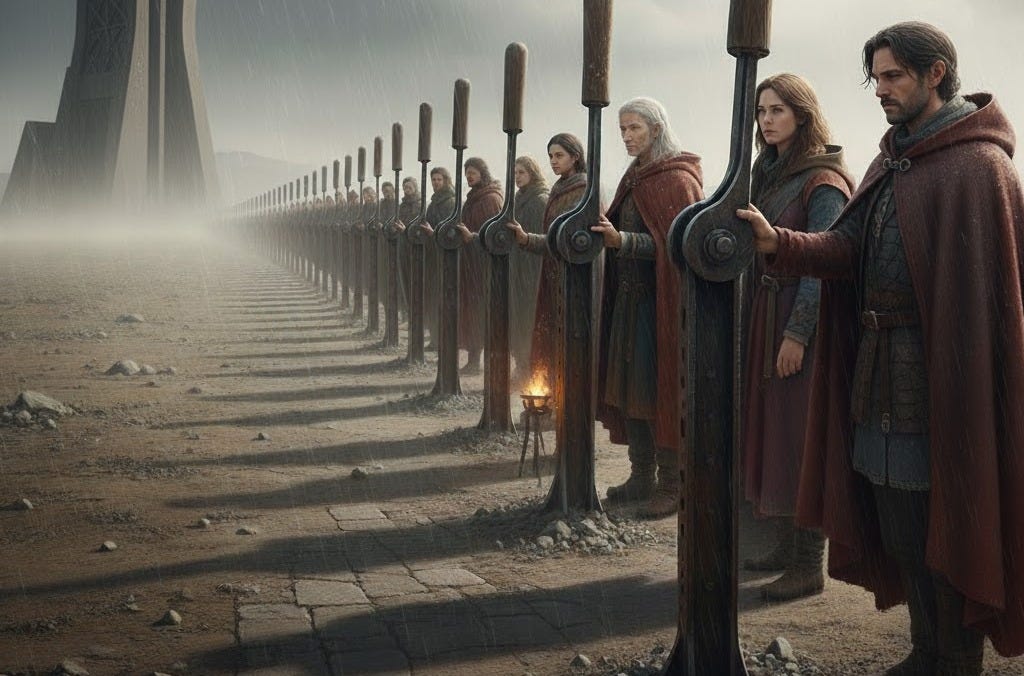
The Bad Old Days
There were 1,000 victims, each of whom started the day with a mild pain. For each victim, there was a torturer, who had his own switch. When a torturer turned the switch, his victim’s pain would be increased by a small amount—too small to be perceptible. But each torturer turned his switch 1,000 times, with the result that every victim spent the day in agony.
Here we have a bad collective action, but it’s obvious that we can blame the individuals. Everyone’s a torturer!
Contrast that with:
The Harmless Torturers
It’s like the Bad Old Days, but with a twist: instead of turning a switch 1,000 times, each torturer presses a button that turns all 1,000 switches one time.
Here we have the same bad result: 1,000 people being tortured. But this time, how could we possibly blame anyone? No individual does any torturing, since no one makes his victims perceptibly worse off. Individually, they are harmless; together, they are torturers.
That’s a shocking paradox. Our ethical theories—applied to certain collective actions—let people get away with torture.
Worse, lots of real collective action problems seem a lot like Parfit’s torturers. Take air pollution. Together, the world emits so many billions of tons of CO₂ that we are literally raising sea levels. But when you drive your car, you barely emit a few kilograms.1 Your emissions seem diffuse and imperceptible—like harmless torture. You might conclude that you don’t have to worry about your contribution. But by that reasoning no one has to worry, and we will all suffer.
Responses
There are two ways out of this problem: (1) show that each Harmless Torturer does something wrong after all; (2) show that real collective action problems aren’t like harmless torture.
Let’s start with the torturers themselves. Is there a way for us to blame them? A natural thought is that each is responsible for his share of the harm that they do together—which means each of the 1,000 torturers is responsible for one victim’s torture, just like in the Bad Old Days.
But this “Share‑of‑the‑Total View” can’t possibly be right, as Parfit (1984: 68) showed with another pair of examples. In:
The First Rescue Mission
100 miners are trapped, and at least four people are needed for a rescue mission. Four volunteers are already on their way. You can either join them as a fifth or go singlehandedly rescue another 10 miners elsewhere.
What should you do? The Share‑of‑the‑Total View says to join the team, since you’ll get credit for saving 20 lives. (Your “share” is 1/5th of 100.) But then only 100 survive rather than 110. Here, the Share‑of‑the‑Total View overrates participating in collective actions. The view also sometimes underrates it. In:
The Second Rescue Mission
The 100 miners are trapped as before, but this time, the rescue mission will require five people. You can either join the big mission as the fifth or go off to single‑handedly rescue 50 others, a mission that needs only one person.
Here, the Share‑of‑the‑Total View says you should save the 50 alone, since you would only get credit for saving 20 if you joined the team. But then only 50 survive rather than 100.

So much for sharing. Another way to blame a Harmless Torturer is to say that even imperceptible pains are bad. They still, according to Parfit’s definition, make a difference to how their victims feel. It’s just a difference that the victim can’t reliably detect, like how you can’t notice subtle shifts in a violin’s pitch. This seems like a fair point. But even if 1,000 tiny pains are bad, how bad could they be? None of the 1,000 victims can even notice the difference! Even if the Harmless Torturers’ acts aren’t harmless, that doesn’t show that they’re even remotely comparable to torture, which means that there isn’t much blame to go around.
A third way to blame the Harmless Torturers is to say, even if their individual actions don’t have bad consequences, they are still forbidden by a deontological principle. A nice idea—but which principle?
Any candidate principle will come with its own problems. Consider Immanuel Kant’s fundamental principle of morality, the Categorical Imperative: “act only in accordance with that maxim through which you can at the same time will that it become a universal law” (4:421). Roughly, this says you should judge an action by how things would turn out if everybody did it. That seems to get the right answer for the Harmless Torturers. If everyone presses their button, the result is just as bad as the Bad Old Days—so the Harmless Torturers do wrong. But what about the First Rescue Mission, where the solution is for you to save the 10 while the others save the 100? In this case, there’s not any single course of action that we should all be taking. As a guide to collective action problems, the Categorical Imperative seems incomplete at best.
What does this mean for real world collective action problems—voting, pollution, and so on? Well, if we want to say that the individuals who contribute to these problems are doing something wrong, and we can’t say the same about the Harmless Torturers, we had better find some difference between the real‑world cases and harmless torture.
There is a lot to say here, but let’s at least consider one important difference. The Harmless Torturers each make an imperceptible difference. But an individual voter, for example, obviously can make a huge difference in an important election. Even the biggest election can be decided by a single vote—in which case every single voter on the winning side makes a difference, since any of them could have flipped the outcome by switching votes. To put it another way, the voters in favor of the good candidate have to reach a threshold corresponding to the number of votes they need to win. Below that threshold, none of the individual votes makes a difference. But each voter can trigger a change if their vote plays an essential role in helping their candidate cross the threshold. Shelly Kagan (2011) calls collective action problems like this triggering cases. In such cases, the chances of triggering a good outcome can (at least in principle) give you a strong moral reason to vote for the better candidate. Even if your vote is probably not going to trigger a victory, when the stakes are high enough, and when the chances of triggering are not too terribly low, you had better vote!
In the wake of Kagan’s work on triggering cases, ethical theorists have explored a bunch of interesting questions. Are all collective action problems, deep down, triggering cases? Can we estimate the chances that someone’s vote will trigger a victory in a real‑world election? Can we expect any help from deontological principles? Could it be that collective actions are wrong even though no individual contributor acts wrongly?
The answers, for now, remain up in the air. And so the Harmless Torturers remain a source of inspiration—and, for some of us, consternation!
Classic Presentation
Derek Parfit, Reasons and Persons (Oxford: Oxford University Press, 1984): Ch. 3.
Responses and Other Treatments
Shelly Kagan, “Do I Make a Difference?” Philosophy & Public Affairs 39 (2011): 105–141.
Zach Barnett, “Why You Should Vote to Change the Outcome,” Philosophy & Public Affairs 48 (2020): 422–446. (Barnett ingeniously argues that the expected value of voting in a big election is much higher than you might think!)
Brian Hedden, “Consequentialism and Collective Action,” Ethics 130 (2020): 530–554.
Julia Nefsky, “How You Can Help, Without Making a Difference,” Philosophical Studies 174 (2017): 2743–2767. (Nefsky argues that you have a reason to participate in the production of collective goods even if you won’t make a difference to whether those goods are produced.)
Further Reading
Immanuel Kant, Groundwork of the Metaphysics of Morals, in his Practical Philosophy, Mary Gregor, ed. and trans. (Cambridge: Cambridge University Press, 1996): 37–108. Allen Wood’s Introduction at pp. 39–40 provides some useful background.
(There are many translations of Kant’s works, but they should all include the standardized page numbers which we have used in the citation above.)
Questions for Reflection
Can you revise the Share‑of‑the‑Total View so that it no longer overrates contributing to collective actions? Does your revision help with the problem of underrating contributions to collective action? (Can any version of the view solve this problem?)
Why might it be important to contribute to a collective good (or abstain from a collective bad) even when one’s action does not make a difference to whether that good is produced? For example, is there any good moral reason to vote when you are unable to change the outcome of the election?
Here’s a more challenging question. We might be tempted to say that it’s wrong for each Harmless Torturer to spread 1,000 pain among 1,000 people, even though we think that’s nowhere near as bad as concentrating lots of pain on a single individual. But this leads to another kind of trouble. Suppose we pair each torturer with a unique victim—say, T1 gets V1, T2 gets V2, and so on up to T1000 and V1000. Now each torturer must choose between concentrating 900 units of pain in his victim or spreading out 1,000 units of pain evenly among all of the victims. If it’s far worse to concentrate pain, each torturer should spread thinly. But then they together cause each victim 1,000 units of pain, whereas if each had concentrated his torture, the victims would have only 900 units of pain. Call this the Hard Version of the Harmless Torturers. What do you think the torturers should do in this case?

Burning one gallon of gasoline emits under one kilogram (2.2 pounds) of CO₂, per the EPA.
I think a natural resolution is that individual moral responsibility simply isn’t well defined in causally complex situations where an individual’s actions can’t be clearly identified as the cause of an outcome. This holds for all the examples you mentioned, and becomes even more complicated once we consider equilibrium effects in collective-action settings. For instance, in a defecting equilibrium where each person’s rational choice is to defect, who could meaningfully be held responsible for the collective failure?
My lay view is that moral theories implicitly depend on a well-defined notion of causation. If that causal structure breaks down, it’s unclear why the associated theory of responsibility should remain valid. In such scenarios, it may be more coherent to rescope the concept of the “agent” to the collective level — treating the resulting harms as coordination problems to be solved institutionally rather than as matters of individual guilt.
A Scanlonian view feels like it resolves this problem pretty well for me. One could reasonably expect that other not torture you, even in small amounts. It's hard to see anyone reasonably reject that. The victim has a much stronger interest in restricting this activity than the torturer has in it being permitted.