


This legislative is not only the supreme power of the commonwealth, but sacred and unalterable in the hands where the community have once placed it…
—John Locke, Second Treatise of Government, §134

A few years ago, I got to have lunch with my favorite political theorist, and I asked him what he thought of abolishing the Electoral College. “Terrible idea,” he said. “It would only make the president more legitimate.”
That was Ian Shapiro, Sterling Professor of Political Science and Global Affairs at Yale, seen here next to a mysterious egg.

To put it mildly, Shapiro’s answer was not what I expected. I was sure he’d bemoan the Electoral College for its bias against big states, who are awarded fewer “electors” per capita. California, for example, has over 67 times the population of Wyoming but only 18 times the electors—which seems pretty unfair!1
But Shapiro doesn’t want a fair Electoral College. By making the presidency more respectable, we would only be further entrenching one of our system’s deepest defects. After a few years of reflection—both on the relevant political science and on current events—I must say that I agree. In fact, I’ll go further: Americans should amend the Constitution to abolish the office of the president.
Of course, any proposal to amend the Constitution deserves to be met with extreme suspicion.
For one thing, the amendment process requires a level of unanimity almost unthinkable in modern American politics. Merely to propose an amendment requires a 2/3rds majority in both the House and Senate.2 To ratify, you need the consent of 38/50 states. The 27th Amendment—which stops Congress from giving itself instant raises—was proposed during the first session of Congress in 1789, and it wasn’t ratified until 1992. There hasn’t been a single ratification since.
Another point worth flagging is that it’s profoundly risky to make changes to a country’s basic institutions. As I’ve argued before, switching systems tends to be costly—both in terms of political capital and transition costs—and often the old system’s problems merely rearise in a new form. Hence my skepticism about abolishing the police: a new regime of “violence interrupters” could just end up being police by another name, as argued by Jake Monaghan.3
I concede both points. Abolishing the president would require an immensely strong political movement and entail gigantic socio-political risks. Nevertheless, I believe the case for presidential abolition is important enough to merit serious discussion, for three reasons.
First, the objections to presidentialism are unusually clear and convincing.
Second, there is a demonstrably viable alternative—namely, parliamentarism.
And, third, even if abolishing the president is infeasible in the short term, it might become possible in the event of a future constitutional crisis—precisely the kind of scenario for which we should be intellectually preparing.
The stakes here are enormous, and no one has laid them out more perspicuously than the Candian philosopher Joseph Heath. In a recent post, Heath writes that Donald Trump “has demonstrated that the U.S. President can issue flagrantly unconstitutional spending orders, in order to avert present crises, and people will follow those orders.” Heath elaborates (emphasis added):
After having spent decades listening to Americans go on and on about their constitution, about the wisdom of the founding fathers, about the genius of their system of checks and balances, it turns out that, when push comes to shove, the constitution does not really constrain the executive. Trump is not just acting in an unconstitutional manner, he is clowning on the U.S. constitution. The executive can move quickly, while courts move slowly, and can easily be obstructed or intimidated. And so if the executive simply does enough stuff, quickly enough, the courts cannot, or will not, keep up. The American system is thereby transformed, practically overnight, from a system of judicial supremacy to one of executive supremacy, ruled by prerogative.
But even though Trump’s maneuvering “exposes a massive vulnerability in the system,” American intellectuals are not rising to the occasion by asking how to fix it. Thus Heath concludes:
The current moment, it seems to me, calls for some Federalist Papers-level debate on how the U.S. political system is to be restructured.
It is in that spirit that I propose that Americans abolish the presidency—not because I’m certain it would work, but because I’m certain we’re not yet thinking big enough.4
Two pitfalls of presidentialism
To start, what is a president? In essence, a president is:
An executive
Directly elected by the people
For a fixed term
Here’s a fuller definition from the political scientist Juan Linz:
In presidential systems an executive with considerable constitutional powers—generally including full control of the composition of the cabinet and administration—is directly elected by the people for a fixed term and is independent of parliamentary votes of confidence. (52)5
Not every executive, however, has to be elected directly by the people. Some are elected by the people’s representatives. That’s the idea behind parliamentarism, in which people directly elect their legislators—the members of parliament—who then select a prime minister to run the government. Since the prime minister’s authority ultimately derives from that of parliament, it’s not too difficult for the parliament to sack a flailing PM, cutting their term short. (British PM Liz Truss famously didn’t even make it 50 days—outlasted by a head of lettuce.)
So the prime minister is:
An executive
Elected by members of parliament
For a flexible term
Or as Linz puts it,
A parliamentary regime in the strict sense is one in which the only democratically legitimate institution is parliament; in such a regime, the government’s authority is completely dependent upon parliamentary confidence. (52)
So the president differs from a prime minster in two ways: the president has independent legitimacy (rather than deriving legitimacy from parliament) and a fixed term (rather than a term adjustable by parliament).6
Both factors make the president worse.
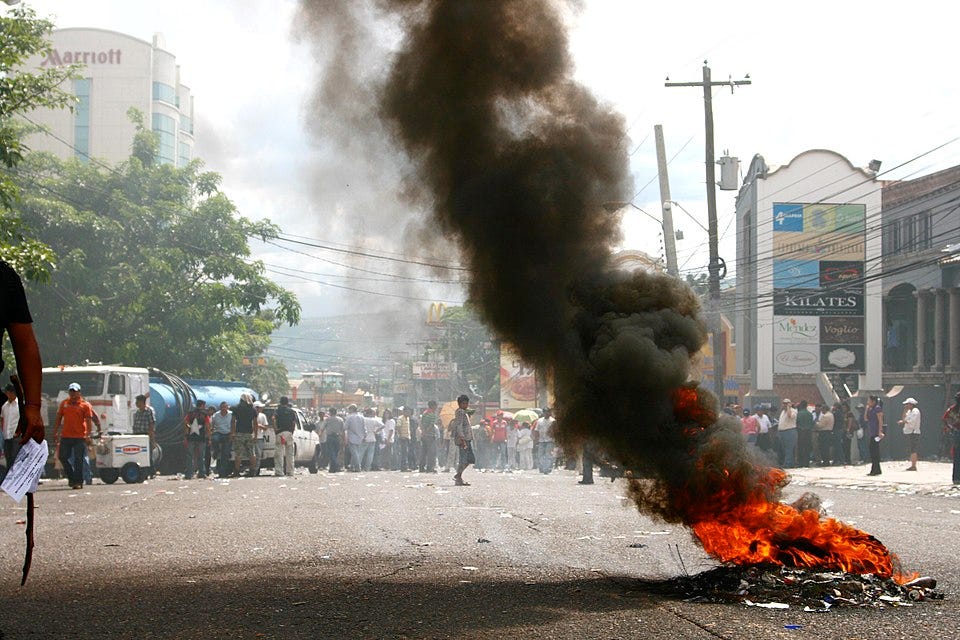
Start with legitimacy. In a parliamentary system, it’s clear who’s really in charge: the parliament. If the PM tries to buck the parliament on behalf of The People, the parliament can convincingly say “No: we represent The People.” In a presidential system, however, the president also represents The People, so it’s unclear who should prevail in an intractable conflict, as Honduras learned the hard way during their coup of 2009. Worse, even the fear of such a conflict may lead presidents to preemptively strike the other branches of government, as argued by the political scientist Gretchen Helmke.

Thus presidential systems have tended to collapse into chaos. As Linz wrote in 1990, only two presidential governments have managed 150 years of “relatively undisturbed constitutional continuity”—the US and Chile. (Though “Chilean democracy broke down in the 1970s.”) Linz continues:
the vast majority of the stable democracies in the world today are parliamentary regimes, where executive power is generated by legislative majorities and depends on such majorities for survival. (51)
Of course, correlation isn’t causation, and the president/parliament distinction isn’t the be all and end all of politics. As Cheibub and Limongi (2002) remind us, “the operation of the political system cannot be entirely derived from the mode of government formation.” Nevertheless, as even they concede, “parliamentarism does outperform presidentialism when it comes to survival.”7
Next, the fixed term. This allows for a certain amount of predictability, but at the cost of making politics more toxic and high-stakes. The core problem here is that whichever party loses the president is largely iced out of power. This makes both the fight for the presidency and the business of government more bitterly zero-sum. Quoth Linz:
Winners and losers are sharply defined for the entire period of the presidential mandate. … the losers must wait at least four or five years without any access to executive power and patronage. The zero-sum game in presidential regimes raises the stakes of presidential elections and inevitably exacerbates their attendant tension and polarization. (56)
But while the president’s term is rigidly fixed, the president himself has paradoxically turned out to be the most flexible, nimble actor in the government. This mixture of “vigor and expedition” is why presidentialism appealed so strongly to Alexander Hamilton; it’s also why Trump is presently “clowning on” the constitutional order. Congress and the courts can stymie the president in limited ways, but in the end, there are few legal methods for getting rid of a president before the end of his allotted term. For Congress to sack a president, a majority of the House has to vote to impeach, and then a supermajority of the Senate has to vote to remove. To declare a president “unable to discharge the powers and duties of his office” and remove him using the 25th Amendment, there has to be support from (i) the Vice President, (ii) a majority of cabinet secretaries, and (iii) supermajorities in both the House and Senate—an “unbelievably high” bar, in the apt words of Jeff Maurer.
Nor can the justice system do much to constrain the US president. In Trump v. United States, the Supreme Court held that the president’s “official acts” while in office are presumptively immune from criminal prosecution, while core presidential acts (such as military orders) enjoy absolute immunity.
Naturally, plenty of anti-Trump commentators have reacted with outrage to this expansion of presidential power, but few have been willing to look beyond the singular persona of Trump to the only proportionate, systematic solution—restricting executive power as such. The Supreme Court won’t do it. Congress can’t do it. The only constitutional way to do it is to amend the Constitution itself.
The solution, in short, is an American parliament.
Unforgivable
To dispel the aura of legitimacy around the president, we’ll need more than abstract arguments: we’ll also need plenty of examples of gross malfeasance and corruption.
To that end, consider the degenerate state of presidential pardons.
Article II of the Constitution gives the president the “Power to grant Reprieves and Pardons for Offences against the United States.” Whatever lofty aspirations the founders had for this power, their hopes were misplaced. Abuses of the pardon began almost as soon as George Washington left office, with a steep crescendo over the last 30 years. Bill Clinton pardoned billionaire Marc Rich, whose ex-wife went on to donate $450,000 to Bill’s presidential library and $100,000 to Hillary’s Senate campaign. Joe Biden promised he wouldn’t pardon his Hunter (a convicted and confessed felon)—then pardoned him, anyway, along with other family members.
In the Trump era, corrupt pardons have reached dystopian proportions. Trump has pardoned scores of political allies for serious crimes (including felonies to which they had pleaded guilty); he has also pardoned many rich and influential people in what appear to be blatant quid pro quo arrangements. In total, not counting a rumored mass pardon of White House staff, Trump’s pardons and commutations total over 1,800. Here are just a handful of the most outrageous examples:
Dinesh D’Souza, a conservative author and filmmaker, pleaded guilty in 2014 to illegal campaign donations. After Trump pardoned him in 2018, D’Souza went on to write and direct multiple films promoting his benefactor, such as Trump Card (2020) and Vindicating Trump (2024). In 2022, D’Souza put out the IQ-dissipating 2000 Mules, which tried to prove Trump’s allegations of voter fraud using anonymized cell phone data: if you happened to pass by a nonprofit 10 times and a drop box 5 times in the run-up to election day, you were counted as a Democrat-hired “mule” and assumed to be dropping off fake votes. (That was the movie’s best argument.) Trump went on to praise D’Souza for having shown that 2020 was indeed marred by “great election fraud.”
Trump pardoned the January 6 rioters en masse, along with 77 people involved in the “fake electors” scheme (which was even worse than it sounds).
One day into his second term, Trump pardoned Ross Ulbricht, founder of the Silk Road, a notorious dark web drug market.
Trump pardoned some of the most blatantly corrupt politicians in modern America, including prolific liar George Santos, who had pleaded guilty to identity theft and wire fraud, and Rod Blagojevich, the disgraced former governor of Illinois, who had been convicted of trying to sell Barack Obama’s Senate seat. Santos is a Trump supporter. Blagojevich now calls himself a “Trumpocrat.”
In 2023, Changpeng “CZ” Zhao—a Chinese-born billionaire and CEO of the cryptocurrency platform Binance—pleaded guilty to violations of the Bank Secrecy Act related to money laundering. These were major crimes. Zhao’s fine was $50 million (plus four months in prison), and Binance was fined over $4 billion. CZ shrewdly hired lobbyists with ties to Trump’s family and struck a multi-billion-dollar deal that benefitted World Liberty Financial, the Trumps’ crypto firm. He was pardoned in October 2025. When 60 Minutes asked Trump why he pardoned CZ, Trump answered, “I don’t know who he is.”
When reflecting on Trump’s corrupt pardons, it’s tempting to conclude that the problem is not the president, but this president. If only. The fact that Trump can do it means that his successors can, too. The notion that any future president would give up power voluntarily—that the presidency will, as if by political gravity, “return to normal”—is pure fantasy. The next president will be in a position not only to consolidate their newfound powers but expand them further. The only way to reverse centuries of descent into unaccountable corruption is to delimit and subordinate the executive’s power—to restore what John Locke would call the supremacy of parliament.
Conclusion
Even if your conscience is shocked; even if you want a way out of our toxic presidential politics; even if you want to make it possible to remove an unpopular executive; even if you want to abolish presidentialism—the whole endeavor might seem hopeless.
How are we supposed to amend the Constitution’s “central design feature” when decades can go by without even a slight tweak at the document’s periphery? How can any movement hope to turn people against the office of the president when that office enjoys such an aura of legitimacy—especially when compared to our dysfunctional Congress? Why shouldn’t we suck it up and try to reform our presidential system rather than pushing for outright abolition?
My answer is simple. The existence of a popular challenge to presidentialism, even if never translated into law, would itself serve as a check on presidential power.
It’s easier for a tyrant to abuse their office when everybody knows there won’t be any consequences. But even an incipient movement against presidential power would be enough to give a tyrant second thoughts. In the event of an atrocity or catatrophe, would the people rise up against the president who caused it? Even the mere possibility constitutes a deterrent threat. In addition, a movement against presidentialism could serve as a wellspring of support for a more active Congress and stronger political parties—both of which would be welcome developments for American democracy.8
Again, I admit to a great deal of uncertainty here. But now is not the time to be indecisive. Eventually, we are going to need to pull our heads out of the sand and have a clear-eyed debate about what’s really going on in our government—and then actually do something about it. Maybe you don’t like my proposal. Very well, then: tell me how you see the problems with the executive branch. Tell me what other reforms you think would offer more bang for buck.
Just don’t blame all our maladies on Dr. Trump. Someday, Trump will be gone, and we will be left with the same broken system that we’ve always had. The problems with presidentialism are enormous—probably too big for any one generation to solve. But we could be the first to try.

This is a downstream consequence of the fact that every state has two senators (regardless of population). For each state, number of electors = number of senators + number of representatives. Thus even the smallest states, which send only one representative to the House, have 2 + 1 = 3 electors.
(See, Bentham's Bulldog: I really do like numbers!)
For the state of the art on voting power and the Electoral College, see Daniel Wodak’s “What Voting Power Cannot Be,” forthcoming in Noûs.
Technically, you could also propose a Constitutional amendment at a constitutional convention at the behest of 2/3rds of the state legislatures. But that’s never actually happened. So don’t bet on it. (Though see n. 8 below for another option.)
Police and prison abolitionists sometimes distinguish between “reformist reforms” (which make the system more tolerable but harder to abolish) and “abolitionist reforms” (which pave the way for total abolition). One of my goals in this post is to warn against “reformist reforms” of the American presidency.
For an important and clear argument in favor of police abolition, see Lauren Lyons (2025), “Why We Should Unbundle the Police,” JESP 30(3).
A notable exception is Matthew Yglesias’s “American democracy is doomed”—a prescient piece, written all the way back in 2015! If you haven’t read it before, I recommend it: Yglesias also draws on Linz and discusses the case of Honduras.
All citations of Linz are to his classic paper “The Perils of Presidentialism,” Journal of Democracy 1(1): 51-69.
There are also various hybrid systems, such as “semi-presidentialism.” For the most part, you can put these on a spectrum from “purely presidential” to “purely parliamentary,” so think of this post as an argument for a significantly more parliamentary form of government.
One particular hybrid deserves a special mention: Steffen Ganghof’s semi-parliamentarism. In Beyond Presidentialism and Parliamentarism, Ganghof argues that the Linz-style critique of presidentialism misses the point, and that the real problem isn’t the “constitutional separation of powers between the executive and the assembly,” but rather “the constitutional concentration of executive power in a single human being” (2021: 1). Ganghof’s preferred system features a bicameral legislature where one chamber selects the PM and cabinet while the other focuses on making and vetoing laws.
I share Ganghof’s concerns about concentrating power in a single executive. Let me also recommend Chapter 9 of his book, which summarizes many objections to presidentialism.
Because parliaments have a strong track record, I am not so worried about Edmund Burke-style calls for maximum caution in presidential reform. In Reflections on the Revolution in France, Burke writes:
…it is with infinite caution that any man ought to venture upon pulling down an edifice which has answered in any tolerable degree for ages the common purposes of society, or on building it up again without having models and patterns of approved utility before his eyes.
But even the US seems to “approve” of the “utility” of parliaments, at least when it comes to other countries. After WWII, when new democracies were being set up in West Germany and Japan, American leaders didn’t push for presidents: they pushed for parliaments.
Let me also note that amending the Constitution might not be as hard as it sounds. Remember the high bar for amendments? That was the bar, in Article V of the Constitution, for an existing government to make amendments. The bar might be lower for an amendment by the people.
In his 1994 paper “The Consent of the Governed: Constitutional Amendment Outside Article V,” Akhil Reed Amar argues that “We the People” have a constitutional right to amend the Constitution via a kind of “national referendum.” I found Amar’s argument convincing, particularly where it touches on the arguments given by the Founders themselves. For example, here is a quotation from James Wilson, one of the six men to sign both the Declaration and the Constitution (and the author of “We the People,” the Constitution’s first three words):
The consequence is, that the people may change the constitutions whenever and however they please. This is a right of which no positive institution can ever deprive them.
Nice to see some uptake on this. My other hot take is that Americans should take France a lot more seriously, when it comes to constitutional reform. My thinking is that you're too far down the route of presidentialism to reverse course now. Also, Congress is not structured to exercise appropriate oversight of the administrative state, the way that cabinet does in a parliamentary system. (Another feature of the Trump administration has been the breakdown of congressional oversight, with the executive branch refusing to turn over documents -- to the legislature! -- refusing to answer questions, etc.) So basically, there is no path that leads from where you are now to legislative supremacy. If you're stuck with executive supremacy then, you might as well try to make it work. And if you look around for a rich liberal democracy where it more-or-less works, probably the best model you can find is France.
Right now, the biggest problem with the new American model of executive supremacy is the atrophy of the legislature, with the replacement of Congressional law-making by executive orders (e.g. the fact that Trump has not tried to pass legislation on tariffs is crazy!) This is, as many people have pointed out, dangerous, because it gives the party in power a strong incentive to not allow the other party to take power, because executive orders can so easily be rescinded. The solution that France adopted to this is to give the President a lot more power over the legislature (esp. appointment of the Prime Minister). By subordinating the legislature to the executive more completely, you at least restore the statutory process, and avoid the sort of Caesarism that America is experiencing now.
The French constitution has some problematic features (I recommend Pierre Rosanvallon's book Good Government as the most cogent defence of it I've seen). France is, however, more functional that the U.S. at the moment. More importantly, I think it's easier to find a path from where the U.S. is now to something like a French model than there is to a parliamentary model.
How about a compromise: we have an executive elected by and accountable to congress, with no pardon or veto power, but we still get to call our executive 'president' ('Prime Minister' sounds too European).