

Last month, the distinguished economist Thomas Sowell was apparently cheering on Trump’s ALL-CAPS anouncement of tariffs on Canada.
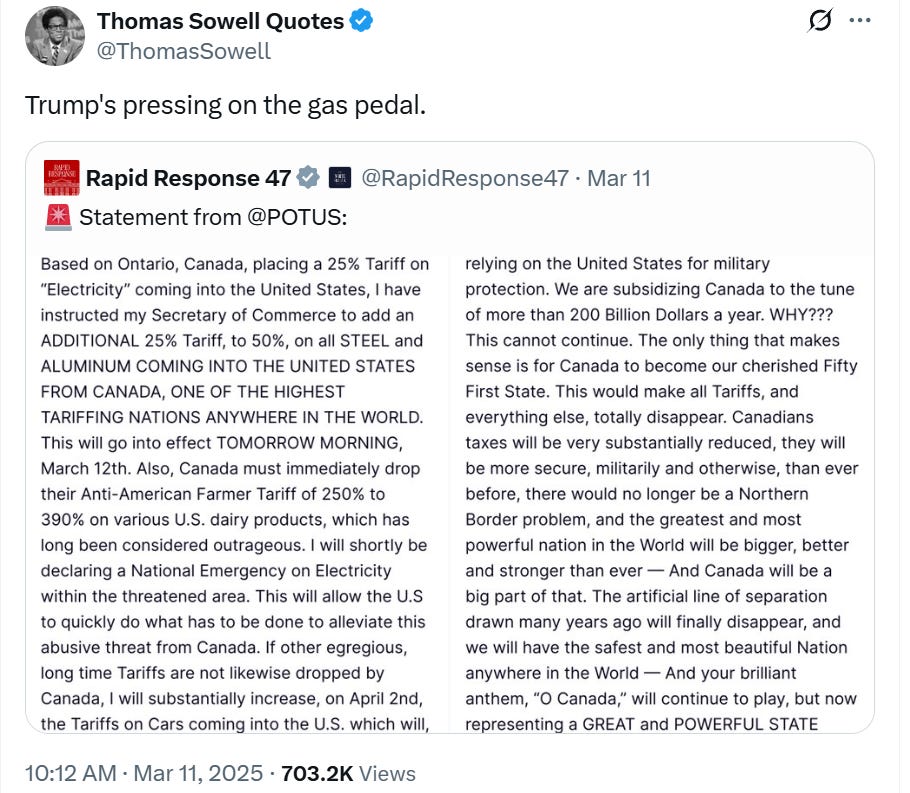
That’s a blue-check account, with the name “Thomas Sowell Quotes” and the handle “@ThomasSowell,” saying stuff that would, in my view, surely make the real Thomas Sowell turn over in his grave.
Knowledge and decisions
Why am I so sure?
For one thing, I’ve read some of Sowell’s books—not all 45 of them, but enough to know how he thinks.
One of Sowell’s big ideas, inspired by Hayek’s GOATed essay, is that society runs on decisions, and good decisions need to draw on lots of knowledge, far too much to cram into the head of any single leader.
Here’s how he explains it in my favorite passage from Knowledge and Decisions (ch. 1):

Physicists have determined that even the most solid and heavy mass of matter we see is mostly empty space. But at the submicroscopic level, specks of matter scattered through a vast emptiness have such incredible density and weight, and are linked to one another by such powerful forces, that together they produce all the properties of concrete, cast iron and solid rock. In much the same way, specks of knowledge are scattered through a vast emptiness of ignorance, and everything depends on how solid the individual specks of knowledge are, and on how powerfully linked and coordinated they are with one another.
To use all the scattered “specks of knowledge,” Sowell thinks we need institutions like markets and prices, which allow people to coordinate actions without having to aggregate what they know. (If you’re new to this idea, treat yourself to Hayek’s “The Use of Knowledge in Society.” Seriously.)1
The desirability of peaceful, decentralized coordination is one of the main arguments for markets—and against tariffs, which are top-down state interventions into markets.2 You can find this same argument in Leonard Read’s “I, Pencil” (animated here), and in Milton Friedman’s intermittently viral paean to free trade:
Sowell in the Trump era
But I’m burying the lede here. Sowell’s still very much alive! And just as you’d expect, he’s out there swinging against Trump’s tariffs.
On the eve of “Liberation Day,” Sowell, now 94, put it succinctly:
What do you make of the present President of the United States and his tariffs?
It’s painful to see such a ruinous decision, from back in the 1920s, being repeated.
It might be okay, Sowell grants, to use tariffs as “a set of short-run ploys with various limited objectives.” And it’s not always “a bad approach” to find policies through trial and error, as did FDR, who was acting within a known system of rules.
But Sowell warns that tariffs could set off an “international trade war” with devastating consequences, and that rising uncertainty could tank the domestic economy.
If you are the one who’s making the rules, then all the other people have no idea what you’re going to do next. And that is the formula for having people hang on to their money until they figure out what you’re going to do. And when a lot of people hang on to their money, you can get results such as you got during the Great Depression of the 1930s
Even during the last Trump term, when his tariffs were far tamer, Sowell voiced his opposition in an interview with Reason.
Thoughts on the Trump trade war?
Oh my gosh, an utter disaster. I happen to believe that the Smoot-Hawley tariffs had more to do with setting off the great depression of the ‘30s than the stock market crash. Unemployment never reached double digits in any of the 12 months that followed the crash of October 1929, but it hit double digits within six months of passage of Smoot-Hawley, and stayed there for a decade.
What about the view by President Trump that other countries are ripping us off by running trade surpluses?
It’s pathetic. The very phrase “trade surpluses” gives half a story. There are countries that supply mainly goods, physical goods, and there are other things like services that other countries provide, and the United States gets a lot of money from providing services. To talk about one part of the trading and ignore the other part fails to understand that money is money no matter whether it’s from goods or services.
When you set off a trade war, like any other war, you have no idea how that’s going to end. You’re going to be blindsided by all kinds of consequences. You do not make America great again by raising the price to Americans, which is what a tariff does.
Long-time readers will know that, in my first post (three weeks ago), I gave my own objection to Trump on “rip-offs.”

Sowell’s objection is more familiar, but if anything more fundamental. If you’re worried about running a “trade deficit” (ooooh, scary—a deficit!), you’ve somehow confused yourself into thinking that it’s necessarily bad to trade money for goods. No matter how low the prices, you’re being ripped off by your grocery store, hairdresser, coffee shop, and favorite bar. Merely buying stuff makes you a sucker.
One wonders what the point of having money is!
BA-BOOM!
This isn’t the first time Sowell’s made these objections. 15 years ago, Sowell laid out the same ideas in an interview with the same guy who spoke with him on April 1.
The punchline:
How much should people really worry about the balance of trade?
Somewhat less than you worry about being struck by lightning.
But why are we talking about this? Just to dunk on a random owner of a blue-check X account?3
Well, partly, yes.
It’s also an excuse to say I think Thomas Sowell is worth reading. I certainly don’t agree with Sowell on everything—just as I don’t agree with Friedman, Hayek, Ostrom, or really anyone about everything. But Sowell is a conservative intellectual, in the honorific sense. He’s a systematic, honest thinker, not a suck-up to whoever’s in power or a sucker for whatever ideas are trendy.
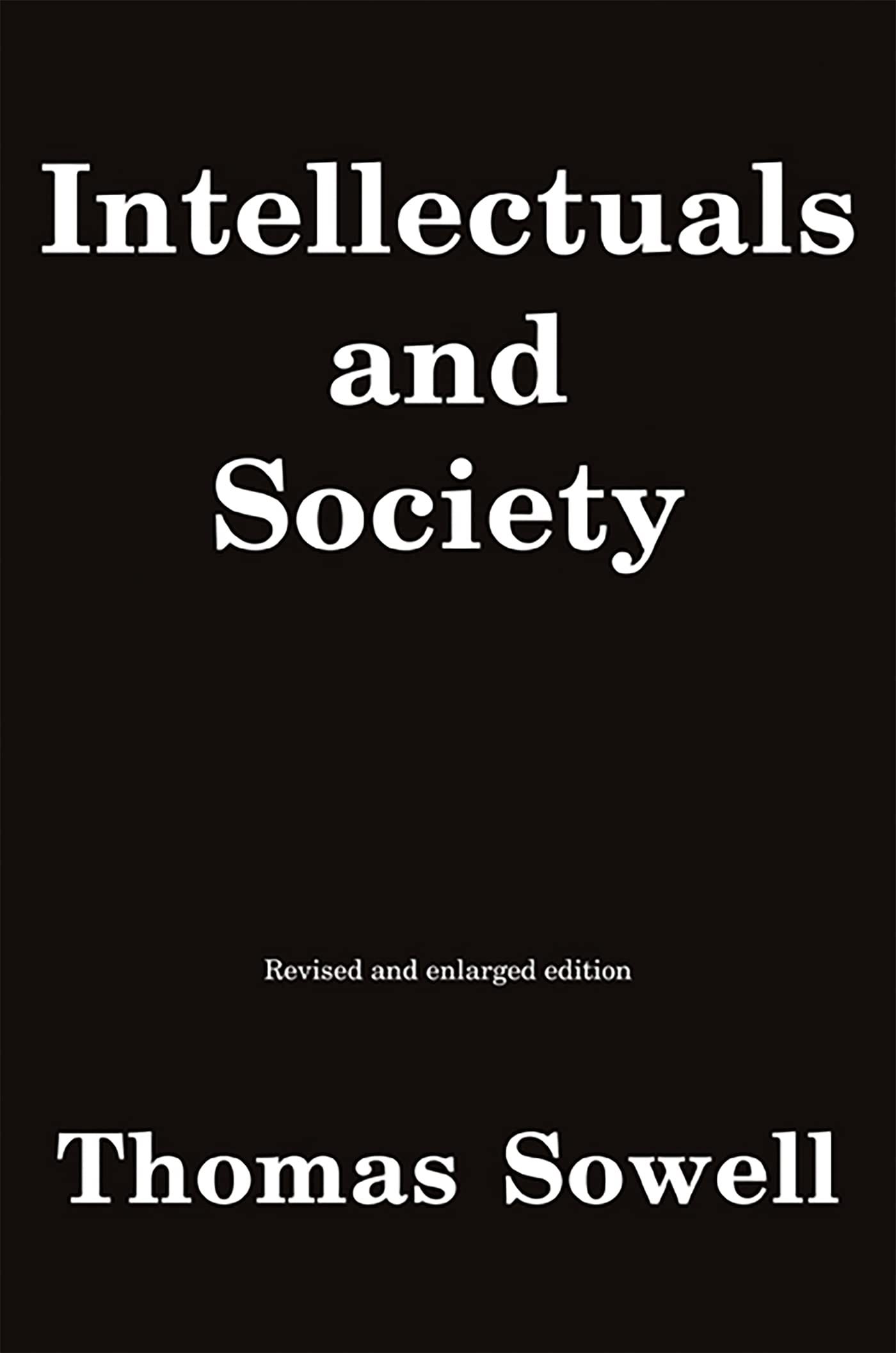
That kind of intellectual, I’m sorry to say, appears to be on the margins of MAGA politics.4 But I applaud Sowell for continuing to speak his mind. Society needs dissent.
If people aren’t brave enough—or original enough—to think beyond the ideas of those in power, then crucial “specks of knowledge” will never make it into our collective decisions, and our collective ignorance will become even vaster and emptier than it already is.
By the way, in 1981, Hayek wrote a review of Sowell’s book, entitled “The Best Book on General Economics in Many a Year.” (I got this from Brian Albrecht’s terrific piece on Sowell’s place in economics.) If you want a more skeptical take on Hayek’s ideas, check out these interesting articles from Corey Robin.
For some similar insights, but without the free market triumphalism, I highly recommend Elinor Ostrom’s Governing the Commons—a marvelous mix of formal modeling and on-the-ground anthropology. (If you want the tl;dr version, subscribe to BIG iff TRUE. I’ll do a post on her before long.)
In my defense, “@ThomasSowell” is still out there posting pro-tariff stuff as of today, yesterday, April 26, April 21, etc.—though it also posted Liz Warren bashing the “economic chaos” of Trump’s tariffs—as well as tariff-hate from John Bolton and Elon Musk. Maybe the original owner of the account sold it to a content farm? Or maybe the owner of “Thomas Sowell Quotes” has realized that, to make money on X, you probably want clickbait of any provenance, not just quotes from Thomas Sowell?
I’ll also note that Black conservatism isn’t always taken seriously in our culture. (Though again let me link to Corey Robin.)
I am here for the good parts of Hayek and Ostrom! Looking forward to more!
I enjoyed that Hayek essay many years ago when I had finished my undergraduate degree. My mentor, a libertarian leaning conservative, was trying to make the impression upon me about bottom up processes and knowledge in economics. It went well with economist Dean Baker’s work at CEPR, and Joseph Heath’s Economics Without Illusions.
Have you read Conflict of Visions by Sowell and if so, what did you think?